Chapter Headings - The Naulahka Poem Rhyme Scheme and Analysis
Rhyme Scheme: ABABCDCD EFGH IJKLJMNOJPQRDSTUVW DDXX YZYZDMA2MMMMMMB2M C2ED2EJJE2E2 F2NF2F2N G2H2G2G2G2I2J2G2G2H2 DDDG2G2 G2G2DDK2K2G2G2J2I2MM PPL2L2YY DDG2D K2G2G2G2 G2M2 G2M2 TN2TN2N2 O2P2O2P2P2| There was a strife 'twixt man and maid | A |
| Oh that was at the birth of time | B |
| But what befall 'twixt man and maid | A |
| Oh that's beyond the grip of rhyme | B |
| 'Twas Sweet I must not bide with you | C |
| And Love I cannot bide alone | D |
| For both were young and both were true | C |
| And both were hard as the nether stone | D |
| - | |
| - | |
| - | |
| Beware the man who's crossed in love | E |
| For pent up steam must find its vent | F |
| Stand back when he is on the move | G |
| And lend him all the Continent | H |
| - | |
| - | |
| - | |
| Your patience Sirs The Devil took me up | I |
| To the burned mountain over Sicily | J |
| Fit place for me and thence I saw my Earth | K |
| Not all Earth's splendour 'twas beyond my need | L |
| And that one spot I love all Earth to me | J |
| And her I love my Heaven What said I | M |
| My love was safe from all the powers of Hell | N |
| For you e'en you acquit her of my guilt | O |
| But Sula nestling by our sail specked sea | J |
| My city child of mine my heart my home | P |
| Mine and my pride evil might visit there | Q |
| It was for Sula and her naked port | R |
| Prey to the galleys of the Algerine | D |
| Our city Sula that I drove my price | S |
| For love of Sula and for love of her | T |
| The twain were woven gold on sackcloth twined | U |
| Past any sundering till God shall judge | V |
| The evil and the good | W |
| - | |
| - | |
| - | |
| Now it is not good for the Christian's health to hustle the Aryan brown | D |
| For the Christian riles and the Aryan smiles and he weareth the Christian down | D |
| And the end of the fight is a tombstone white with the name of the late deceased | X |
| And the epitaph drear A Fool lies here who tried to hustle the East | X |
| - | |
| - | |
| - | |
| There is pleasure in the wet wet clay | Y |
| When the artist's hand is potting it | Z |
| There is pleasure in the wet wet lay | Y |
| When the poet's pad is blotting it | Z |
| There is pleasure in the shine of your picture on the line | D |
| At the Royal Acade my | M |
| But the pleasure felt in these is as chalk to Cheddar cheese | A2 |
| When it comes to a well made Lie | M |
| To a quite unwreckable Lie | M |
| To a most impeccable Lie | M |
| To a watertight fire proof angle iron sunk hinge time lock steel faced Lie | M |
| Not a private hansom Lie | M |
| But a pair and brougham Lie | M |
| Not a little place at Tooting but a country house with shooting | B2 |
| And a ring fence deer park Lie | M |
| - | |
| - | |
| - | |
| When a lover hies abroad | C2 |
| Looking for his love | E |
| Azrael smiling sheathes his sword | D2 |
| Heaven smiles above | E |
| Earth and sea | J |
| His servants be | J |
| And to lesser compass round | E2 |
| That his love be sooner found | E2 |
| - | |
| - | |
| - | |
| We meet in an evil land | F2 |
| That is near to the gates of hell | N |
| I wait for thy command | F2 |
| To serve to speed or withstand | F2 |
| And thou sayest I do not well | N |
| - | |
| Oh Love the flowers so red | G2 |
| Are only tongues of flame | H2 |
| The earth is full of the dead | G2 |
| The new killed restless dead | G2 |
| There is danger beneath and o'erhead | G2 |
| And I guard thy gates in fear | I2 |
| Of words thou canst not hear | J2 |
| Of peril and jeopardy | G2 |
| Of signs thou canst not see | G2 |
| And thou sayest 'tis ill that I came | H2 |
| - | |
| - | |
| - | |
| This I saw when the rites were done | D |
| And the lamps were dead and the Gods alone | D |
| And the grey snake coiled on the altar stone | D |
| Ere I fled from a Fear that I could not see | G2 |
| And the Gods of the East made mouths at me | G2 |
| - | |
| - | |
| - | |
| Beat off in our last fight were we | G2 |
| The greater need to seek the sea | G2 |
| For Fortune changeth as the moon | D |
| To caravel and picaroon | D |
| Then Eastward Ho or Westward Ho | K2 |
| Whichever wind may meetest blow | K2 |
| Our quarry sails on either sea | G2 |
| Fat prey for such bold lads as we | G2 |
| And every sun dried buccaneer | J2 |
| Must hand and reef and watch and steer | I2 |
| And bear great wrath of sea and sky | M |
| Before the plate ships wallow by | M |
| Now as our tall bows take the foam | P |
| Let no man turn his heart to home | P |
| Save to desire treasure more | L2 |
| And larger warehouse for his store | L2 |
| When treasure won from Santos Bay | Y |
| Shall make our sea washed village gay | Y |
| - | |
| - | |
| - | |
| Because I sought it far from men | D |
| In deserts and alone | D |
| I found it burning overhead | G2 |
| The jewel of a Throne | D |
| - | |
| Because I sought I sought it so | K2 |
| And spent my days to find | G2 |
| It blazed one moment ere it left | G2 |
| The blacker night behind | G2 |
| - | |
| - | |
| - | |
| We be the Gods of the East | G2 |
| Older than all | M2 |
| - | |
| Masters of Mourning and Feast | G2 |
| How shall we fall | M2 |
| - | |
| - | |
| - | |
| Will they gape for the husks that ye proffer | T |
| Or yearn to your song | N2 |
| And we have we nothing to offer | T |
| Who ruled them so long | N2 |
| In the fume of the incense the clash of the cymbals the blare of the conch and the gong | N2 |
| - | |
| Over the strife of the schools | O2 |
| Low the day burns | P2 |
| Back with the kine from the pools | O2 |
| Each one returns | P2 |
| To the life that he knows where the altar flame glows and the tulsi is trimmed in the urns | P2 |
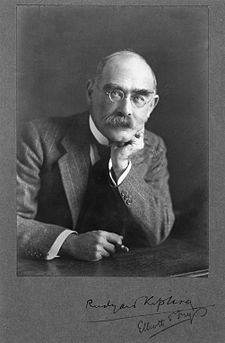
Rudyard Kipling
(1)
Poem topics: , Print This Poem , Rhyme Scheme
Submit Spanish Translation
Submit German Translation
Submit French Translation
About Chapter Headings - The Naulahka
Chapter Headings - The Naulahka is a poem by Rudyard Kipling. This page includes the poem text, poet information, related topics, comments, and similar poems.
Write your comment about Chapter Headings - The Naulahka poem by Rudyard Kipling
Best Poems of Rudyard Kipling