Baucis And Philemon Poem Rhyme Scheme and Analysis
Rhyme Scheme: AABBCCDDEEFFGGHHIIJJ CCKKLLMMNNOOPPQQRRSS BTDUVVOOWXYZKKKA2B2B 2C2C2D2D2E2E2F2F2G2G 2H2KI2I2KKI2I2J2J2I2 I2K2K2L2L2M2M2SSC2C2 I2I2M2N2I2I2KKO2O2I2 I2P2Q2R2R2S2S2I2I2T2 T2U2U2S2XG2G2V2V2SSI 2I2Q2Q2I2I2I2I2I2I2U 2U2W2W2U2U2U2U2X2X2U 2U2WWY2Y2Z2Z2I2I2A3A 3I2XB3B3SSI2XQ2Q2U2U 2I2I2C3C3SSU2U2I2I2I 2I2| IN ancient times as story tells | A |
| The saints would often leave their cells | A |
| And stroll about but hide their quality | B |
| To try good people's hospitality | B |
| It happened on a winter night | C |
| As authors of the legend write | C |
| Two brother hermits saints by trade | D |
| Taking their tour in masquerade | D |
| Disguised in tattered habits went | E |
| To a small village down in Kent | E |
| Where in the strollers' canting strain | F |
| They begged from door to door in vain | F |
| Tried every tone might pity win | G |
| But not a soul would let them in | G |
| Our wandering saints in woeful state | H |
| Treated at this ungodly rate | H |
| Having through all the village passed | I |
| To a small cottage came at last | I |
| Where dwelt a good honest old yeoman | J |
| Called in the neighbourhood Philemon | J |
| Who kindly did these saints invite | C |
| In his poor hut to pass the night | C |
| And then the hospitable Sire | K |
| Bid goody Baucis mend the fire | K |
| While he from out the chimney took | L |
| A flitch of bacon off the hook | L |
| And freely from the fattest side | M |
| Cut out large slices to be fried | M |
| Then stepped aside to fetch 'em drink | N |
| Filled a large jug up to the brink | N |
| And saw it fairly twice go round | O |
| Yet what is wonderful they found | O |
| 'Twas still replenished to the top | P |
| As if they ne'er had touched a drop | P |
| The good old couple were amazed | Q |
| And often on each other gazed | Q |
| For both were frightened to the heart | R |
| And just began to cry What art | R |
| Then softly turned aside to view | S |
| Whether the lights were burning blue | S |
| The gentle pilgrims soon aware on't | B |
| Told 'em their calling and their errant | T |
| 'Good folks you need not be afraid | D |
| We are but saints ' the hermits said | U |
| 'No hurt shall come to you or yours | V |
| But for that pack of churlish boors | V |
| Not fit to live on Christian ground | O |
| They and their houses shall be drowned | O |
| Whilst you shall see your cottage rise | W |
| And grow a church before your eyes ' | X |
| They scarce had spoke when fair and soft | Y |
| The roof began to mount aloft | Z |
| Aloft rose every beam and rafter | K |
| The heavy wall climbed slowly after | K |
| The chimney widened and grew higher | K |
| Became a steeple with a spire | A2 |
| The kettle to the top was hoist | B2 |
| And there stood fastened to a joist | B2 |
| But with the upside down to show | C2 |
| Its inclination for below | C2 |
| In vain for a superior force | D2 |
| Applied at bottom stops its coarse | D2 |
| Doomed ever in suspense to dwell | E2 |
| 'Tis now no kettle but a bell | E2 |
| A wooden jack which had almost | F2 |
| Lost by disuse the art to roast | F2 |
| A sudden alteration feels | G2 |
| Increased by new intestine wheels | G2 |
| And what exalts the wonder more | H2 |
| The number made the motion slower | K |
| The flyer though 't had leaden feet | I2 |
| Turned round so quick you scarce could see 't | I2 |
| But slackened by some secret power | K |
| Now hardly moves an inch an hour | K |
| The jack and chimney near allied | I2 |
| Had never left each other's side | I2 |
| The chimney to a steeple grown | J2 |
| The jack would not be left alone | J2 |
| But up against the steeple reared | I2 |
| Became a clock and still adhered | I2 |
| And still its love to household cares | K2 |
| By a shrill voice at noon declares | K2 |
| Warning the cook maid not to burn | L2 |
| That roast meat which it cannot turn | L2 |
| The groaning chair began to crawl | M2 |
| Like a huge snail along the wall | M2 |
| There stuck aloft in public view | S |
| And with small change a pulpit grew | S |
| The porringers that in a row | C2 |
| Hung high and made a glittering show | C2 |
| To a less noble substance changed | I2 |
| Were now but leathern buckets ranged | I2 |
| The ballads pasted on the wall | M2 |
| Of Joan of France and English Moll | N2 |
| Fair Rosamond and Robin Hood | I2 |
| The Little Children in the Wood | I2 |
| Now seemed to look abundance better | K |
| Improved in picture size and letter | K |
| And high in order placed describe | O2 |
| The heraldry of every tribe | O2 |
| A bedstead of the antique mode | I2 |
| Compact of timber many a load | I2 |
| Such as our ancestors did use | P2 |
| Was metamorphosed into pews | Q2 |
| Which still their ancient nature keep | R2 |
| By lodging folks disposed to sleep | R2 |
| The cottage by such feats as these | S2 |
| Grown to a church by just degrees | S2 |
| The hermits then desired their host | I2 |
| To ask for what he fancied most | I2 |
| Philemon having paused a while | T2 |
| Returned 'em thanks in homely style | T2 |
| Then said 'My house is grown so fine | U2 |
| Methinks I still would call it mine | U2 |
| I'm old and fain would live at ease | S2 |
| Make me the Parson if you please ' | X |
| He spoke and presently he feels | G2 |
| His grazier's coat fall down his heels | G2 |
| He sees yet hardly can believe | V2 |
| About each arm a pudding sleeve | V2 |
| His waistcoat to a cassock grew | S |
| And both assumed a sable hue | S |
| But being old continued just | I2 |
| As thread bare and as full of dust | I2 |
| His talk was now of tithes and dues | Q2 |
| He smoked his pipe and read the news | Q2 |
| Knew how to preach old sermons next | I2 |
| Vamped in the preface and the text | I2 |
| At christenings well could act his part | I2 |
| And had the service all by heart | I2 |
| Wished women might have children fast | I2 |
| And thought whose sow had farrowed last | I2 |
| Against Dissenters would repine | U2 |
| And stood up firm for Right divine | U2 |
| Found his head filled with many a system | W2 |
| But classic authors he ne'er missed 'em | W2 |
| Thus having furbished up a parson | U2 |
| Dame Baucis next they played their farce on | U2 |
| Instead of home spun coifs were seen | U2 |
| Good pinners edg'd with colberteen | U2 |
| Her petticoat transformed apace | X2 |
| Became black satin flounced with lace | X2 |
| Plain Goody would no longer down | U2 |
| 'Twas Madam in her grogram gown | U2 |
| Philemon was in great surprise | W |
| And hardly could believe his eyes | W |
| Amazed to see her look so prim | Y2 |
| And she admired as much at him | Y2 |
| Thus happy in their change of life | Z2 |
| Were several years this man and wife | Z2 |
| When on a day which proved their last | I2 |
| Discoursing o'er old stories past | I2 |
| They went by chance amidst their talk | A3 |
| To the church yard to take a walk | A3 |
| When Baucis hastily cried out | I2 |
| 'My dear I see your forehead sprout ' | X |
| 'Sprout ' quoth the man 'what's this you tell us | B3 |
| I hope you don't believe me jealous | B3 |
| But yet methinks I feel it true | S |
| And really yours is budding too | S |
| Nay now I cannot stir my foot | I2 |
| It feels as if 'twere taking root ' | X |
| Description would but tire my Muse | Q2 |
| In short they both were turned to Yews | Q2 |
| Old Goodman Dobson of the green | U2 |
| Remembers he the trees has seen | U2 |
| He'll talk of them from noon till night | I2 |
| And goes with folks to show the sight | I2 |
| On Sundays after evening prayer | C3 |
| He gathers all the parish there | C3 |
| Points out the place of either Yew | S |
| Here Baucis there Philemon grew | S |
| Till once a parson of our town | U2 |
| To mend his barn cut Baucis down | U2 |
| At which 'tis hard to be believed | I2 |
| How much the other tree was grieved | I2 |
| Grow scrubby died a top was stunted | I2 |
| So the next parson stubbed and burnt it | I2 |
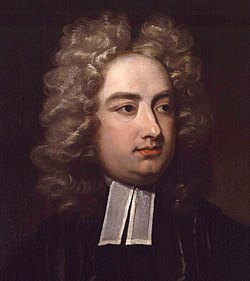
Jonathan Swift
(1)
Poem topics: , Print This Poem , Rhyme Scheme
Submit Spanish Translation
Submit German Translation
Submit French Translation
About Baucis And Philemon
Baucis And Philemon is a poem by Jonathan Swift. This page includes the poem text, poet information, related topics, comments, and similar poems.
Write your comment about Baucis And Philemon poem by Jonathan Swift
Best Poems of Jonathan Swift