Baucis And Philemon[1] Poem Rhyme Scheme and Analysis
Rhyme Scheme: A BBAAAAAAAACCDDAAAAEF AAGGHHAAIIAAJJAAAAKK AAAALLAAMMAAGGGNAAOO PPQQAARRSGAAGGAATTAA UUVVWWKKOOAAWWAAGGXX AAYZA2A2B2B2AAC2C2D2 D2B2B2RRE2E2KKAAZZAA AAAAD2D2F2F2D2D2D2D2 G2G2D2D2MMH2H2I2I2AA J2J2AAK2K2KD2AAZZD2D 2AAL2L2KKD2D2AAAA| ON THE EVER LAMENTED LOSS OF THE TWO YEW TREES IN THE PARISH OF CHILTHORNE SOMERSET IMITATED FROM THE EIGHTH BOOK OF OVID | A |
| - | |
| In ancient times as story tells | B |
| The saints would often leave their cells | B |
| And stroll about but hide their quality | A |
| To try good people's hospitality | A |
| It happen'd on a winter night | A |
| As authors of the legend write | A |
| Two brother hermits saints by trade | A |
| Taking their tour in masquerade | A |
| Disguis'd in tatter'd habits went | A |
| To a small village down in Kent | A |
| Where in the strollers' canting strain | C |
| They begg'd from door to door in vain | C |
| Try'd ev'ry tone might pity win | D |
| But not a soul would let them in | D |
| Our wand'ring saints in woful state | A |
| Treated at this ungodly rate | A |
| Having thro' all the village past | A |
| To a small cottage came at last | A |
| Where dwelt a good old honest ye'man | E |
| Call'd in the neighbourhood Philemon | F |
| Who kindly did these saints invite | A |
| In his poor hut to pass the night | A |
| And then the hospitable sire | G |
| Bid Goody Baucis mend the fire | G |
| While he from out the chimney took | H |
| A flitch of bacon off the hook | H |
| And freely from the fattest side | A |
| Cut out large slices to be fry'd | A |
| Then stepp'd aside to fetch 'em drink | I |
| Fill'd a large jug up to the brink | I |
| And saw it fairly twice go round | A |
| Yet what was wonderful they found | A |
| 'Twas still replenished to the top | J |
| As if they ne'er had touch'd a drop | J |
| The good old couple were amaz'd | A |
| And often on each other gaz'd | A |
| For both were frighten'd to the heart | A |
| And just began to cry What art | A |
| Then softly turn'd aside to view | K |
| Whether the lights were burning blue | K |
| The gentle pilgrims soon aware on't | A |
| Told them their calling and their errand | A |
| Good folk you need not be afraid | A |
| We are but saints the hermits said | A |
| No hurt shall come to you or yours | L |
| But for that pack of churlish boors | L |
| Not fit to live on Christian ground | A |
| They and their houses shall be drown'd | A |
| While you shall see your cottage rise | M |
| And grow a church before your eyes | M |
| They scarce had spoke when fair and soft | A |
| The roof began to mount aloft | A |
| Aloft rose ev'ry beam and rafter | G |
| The heavy wall climb'd slowly after | G |
| The chimney widen'd and grew higher | G |
| Became a steeple with a spire | N |
| The kettle to the top was hoist | A |
| And there stood fasten'd to a joist | A |
| But with the upside down to show | O |
| Its inclination for below | O |
| In vain for a superior force | P |
| Applied at bottom stops its course | P |
| Doom'd ever in suspense to dwell | Q |
| 'Tis now no kettle but a bell | Q |
| A wooden jack which had almost | A |
| Lost by disuse the art to roast | A |
| A sudden alteration feels | R |
| Increas'd by new intestine wheels | R |
| And what exalts the wonder more | S |
| The number made the motion slower | G |
| The flyer though it had leaden feet | A |
| Turn'd round so quick you scarce could see't | A |
| But slacken'd by some secret power | G |
| Now hardly moves an inch an hour | G |
| The jack and chimney near ally'd | A |
| Had never left each other's side | A |
| The chimney to a steeple grown | T |
| The jack would not be left alone | T |
| But up against the steeple rear'd | A |
| Became a clock and still adher'd | A |
| And still its love to household cares | U |
| By a shrill voice at noon declares | U |
| Warning the cookmaid not to burn | V |
| That roast meat which it cannot turn | V |
| The groaning chair began to crawl | W |
| Like an huge snail half up the wall | W |
| There stuck aloft in public view | K |
| And with small change a pulpit grew | K |
| The porringers that in a row | O |
| Hung high and made a glitt'ring show | O |
| To a less noble substance chang'd | A |
| Were now but leathern buckets rang'd | A |
| The ballads pasted on the wall | W |
| Of Joan of France and English Mall | W |
| Fair Rosamond and Robin Hood | A |
| The little Children in the Wood | A |
| Now seem'd to look abundance better | G |
| Improved in picture size and letter | G |
| And high in order plac'd describe | X |
| The heraldry of ev'ry tribe | X |
| A bedstead of the antique mode | A |
| Compact of timber many a load | A |
| Such as our ancestors did use | Y |
| Was metamorphos'd into pews | Z |
| Which still their ancient nature keep | A2 |
| By lodging folk disposed to sleep | A2 |
| The cottage by such feats as these | B2 |
| Grown to a church by just degrees | B2 |
| The hermits then desired their host | A |
| To ask for what he fancy'd most | A |
| Philemon having paused a while | C2 |
| Return'd them thanks in homely style | C2 |
| Then said My house is grown so fine | D2 |
| Methinks I still would call it mine | D2 |
| I'm old and fain would live at ease | B2 |
| Make me the parson if you please | B2 |
| He spoke and presently he feels | R |
| His grazier's coat fall down his heels | R |
| He sees yet hardly can believe | E2 |
| About each arm a pudding sleeve | E2 |
| His waistcoat to a cassock grew | K |
| And both assumed a sable hue | K |
| But being old continued just | A |
| As threadbare and as full of dust | A |
| His talk was now of tithes and dues | Z |
| Could smoke his pipe and read the news | Z |
| Knew how to preach old sermons next | A |
| Vamp'd in the preface and the text | A |
| At christ'nings well could act his part | A |
| And had the service all by heart | A |
| Wish'd women might have children fast | A |
| And thought whose sow had farrow'd last | A |
| Against dissenters would repine | D2 |
| And stood up firm for right divine | D2 |
| Found his head fill'd with many a system | F2 |
| But classic authors he ne'er mist 'em | F2 |
| Thus having furbish'd up a parson | D2 |
| Dame Baucis next they play'd their farce on | D2 |
| Instead of homespun coifs were seen | D2 |
| Good pinners edg'd with colberteen | D2 |
| Her petticoat transform'd apace | G2 |
| Became black satin flounced with lace | G2 |
| Plain Goody would no longer down | D2 |
| 'Twas Madam in her grogram gown | D2 |
| Philemon was in great surprise | M |
| And hardly could believe his eyes | M |
| Amaz'd to see her look so prim | H2 |
| And she admir'd as much at him | H2 |
| Thus happy in their change of life | I2 |
| Were several years this man and wife | I2 |
| When on a day which prov'd their last | A |
| Discoursing o'er old stories past | A |
| They went by chance amidst their talk | J2 |
| To the churchyard to take a walk | J2 |
| When Baucis hastily cry'd out | A |
| My dear I see your forehead sprout | A |
| Sprout quoth the man what's this you tell us | K2 |
| I hope you don't believe me jealous | K2 |
| But yet methinks I feel it true | K |
| And really yours is budding too Nay now | D2 |
| I cannot stir my foot | A |
| It feels as if 'twere taking root | A |
| Description would but tire my Muse | Z |
| In short they both were turn'd to yews | Z |
| Old Goodman Dobson of the Green | D2 |
| Remembers he the trees has seen | D2 |
| He'll talk of them from noon till night | A |
| And goes with folk to show the sight | A |
| On Sundays after evening prayer | L2 |
| He gathers all the parish there | L2 |
| Points out the place of either yew | K |
| Here Baucis there Philemon grew | K |
| Till once a parson of our town | D2 |
| To mend his barn cut Baucis down | D2 |
| At which 'tis hard to be believ'd | A |
| How much the other tree was griev'd | A |
| Grew scrubby dy'd a top was stunted | A |
| So the next parson stubb'd and burnt it | A |
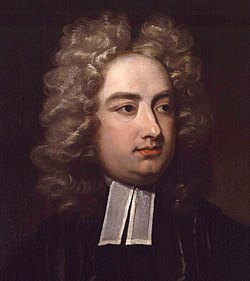
Jonathan Swift
(1)
Poem topics: , Print This Poem , Rhyme Scheme
Submit Spanish Translation
Submit German Translation
Submit French Translation
About Baucis And Philemon[1]
Baucis And Philemon[1] is a poem by Jonathan Swift. This page includes the poem text, poet information, related topics, comments, and similar poems.
Write your comment about Baucis And Philemon[1] poem by Jonathan Swift
Best Poems of Jonathan Swift