To Her Grace The Duchess Of Ormond,[1] Poem Rhyme Scheme and Analysis
Rhyme Scheme: A B CDEEFF AAGH AAAAIIJJ HHKKKLLMNOOPPQQAAAAR RAASSTTUUAAASRAAJJAA AAAGGAASSAAVVAAAIIIA AOOTTWWQQHH AAXYAA AAATT ZA2TTAA AAB2B2 C2C2SSFFD2E2E2 F2G2H2H2ZAAAAI2I2 AARRAAQQOOJ2AAAA AARRRAASSC2C2 RRK2K2AAL2M2C2C2KK| WITH THE FOLLOWING POEM OF PALAMON AND ARCITE | A |
| - | |
| - | |
| MADAM | B |
| - | |
| The bard who first adorn'd our native tongue | C |
| Tuned to his British lyre this ancient song | D |
| Which Homer might without a blush rehearse | E |
| And leaves a doubtful palm in Virgil's verse | E |
| He match'd their beauties where they most excel | F |
| Of love sung better and of arms as well | F |
| - | |
| Vouchsafe illustrious Ormond to behold | A |
| What power the charms of beauty had of old | A |
| Nor wonder if such deeds of arms were done | G |
| Inspired by two fair eyes that sparkled like your own | H |
| - | |
| If Chaucer by the best idea wrought | A |
| And poets can divine each other's thought | A |
| The fairest nymph before his eyes he set | A |
| And then the fairest was Plantagenet | A |
| Who three contending princes made her prize | I |
| And ruled the rival nations with her eyes | I |
| Who left immortal trophies of her fame | J |
| And to the noblest order gave the name | J |
| - | |
| Like her of equal kindred to the throne | H |
| You keep her conquests and extend your own | H |
| As when the stars in their ethereal race | K |
| At length have roll'd around the liquid space | K |
| At certain periods they resume their place | K |
| From the same point of heaven their course advance | L |
| And move in measures of their former dance | L |
| Thus after length of ages she returns | M |
| Restored in you and the same place adorns | N |
| Or you perform her office in the sphere | O |
| Born of her blood and make a new Platonic year | O |
| O true Plantagenet O race divine | P |
| For beauty still is fatal to the line | P |
| Had Chaucer lived that angel face to view | Q |
| Sure he had drawn his Emily from you | Q |
| Or had you lived to judge the doubtful right | A |
| Your noble Palamon had been the knight | A |
| And conquering Theseus from his side had sent | A |
| Your generous lord to guide the Theban government | A |
| Time shall accomplish that and I shall see | R |
| A Palamon in him in you an Emily | R |
| Already have the Fates your path prepared | A |
| And sure presage your future sway declared | A |
| When westward like the sun you took your way | S |
| And from benighted Britain bore the day | S |
| Blue Triton gave the signal from the shore | T |
| The ready Nereids heard and swam before | T |
| To smooth the seas a soft Etesian gale | U |
| But just inspired and gently swell'd the sail | U |
| Portunus took his turn whose ample hand | A |
| Heaved up his lighten'd keel and sunk the sand | A |
| And steer'd the sacred vessel safe to land | A |
| The land if not restrain'd had met your way | S |
| Projected out a neck and jutted to the sea | R |
| Hibernia prostrate at your feet adored | A |
| In you the pledge of her expected lord | A |
| Due to her isle a venerable name | J |
| His father and his grandsire known to fame | J |
| Awed by that house accustom'd to command | A |
| The sturdy kerns in due subjection stand | A |
| Nor bear the reins in any foreign hand | A |
| At your approach they crowded to the port | A |
| And scarcely landed you create a court | A |
| As Ormond's harbinger to you they run | G |
| For Venus is the promise of the sun | G |
| The waste of civil wars their towns destroy'd | A |
| Pales unhonour'd Ceres unemploy'd | A |
| Were all forgot and one triumphant day | S |
| Wiped all the tears of three campaigns away | S |
| Blood rapines massacres were cheaply bought | A |
| So mighty recompence your beauty brought | A |
| As when the dove returning bore the mark | V |
| Of earth restored to the long labouring ark | V |
| The relics of mankind secure of rest | A |
| Oped every window to receive the guest | A |
| And the fair bearer of the message bless'd | A |
| So when you came with loud repeated cries | I |
| The nation took an omen from your eyes | I |
| And God advanced his rainbow in the skies | I |
| To sign inviolable peace restored | A |
| The saints with solemn shouts proclaim'd the new accord | A |
| When at your second coming you appear | O |
| For I foretell that millenary year | O |
| The sharpen'd share shall vex the soil no more | T |
| But earth unbidden shall produce her store | T |
| The land shall laugh the circling ocean smile | W |
| And Heaven's indulgence bless the holy isle | W |
| Heaven from all ages has reserved for you | Q |
| That happy clime which venom never knew | Q |
| Or if it had been there your eyes alone | H |
| Have power to chase all poison but their own | H |
| - | |
| Now in this interval which Fate has cast | A |
| Betwixt your future glories and your past | A |
| This pause of power 'tis Ireland's hour to mourn | X |
| While England celebrates your safe return | Y |
| By which you seem the seasons to command | A |
| And bring our summers back to their forsaken land | A |
| - | |
| The vanquish'd isle our leisure must attend | A |
| Till the fair blessing we vouchsafe to send | A |
| Nor can we spare you long though often we may lend | A |
| The dove was twice employ'd abroad before | T |
| The world was dried and she return'd no more | T |
| - | |
| Nor dare we trust so soft a messenger | Z |
| New from her sickness to that northern air | A2 |
| Rest here a while your lustre to restore | T |
| That they may see you as you shone before | T |
| For yet the eclipse not wholly past you wade | A |
| Through some remains and dimness of a shade | A |
| - | |
| A subject in his prince may claim a right | A |
| Nor suffer him with strength impair'd to fight | A |
| Till force returns his ardour we restrain | B2 |
| And curb his warlike wish to cross the main | B2 |
| - | |
| Now past the danger let the learn'd begin | C2 |
| The inquiry where disease could enter in | C2 |
| How those malignant atoms forced their way | S |
| What in the faultless frame they found to make their prey | S |
| Where every element was weigh'd so well | F |
| That Heaven alone who mix'd the mass could tell | F |
| Which of the four ingredients could rebel | D2 |
| And where imprison'd in so sweet a cage | E2 |
| A soul might well be pleased to pass an age | E2 |
| - | |
| And yet the fine materials made it weak | F2 |
| Porcelain by being pure is apt to break | G2 |
| Even to your breast the sickness durst aspire | H2 |
| And forced from that fair temple to retire | H2 |
| Profanely set the holy place on fire | Z |
| In vain your lord like young Vespasian mourn'd | A |
| When the fierce flames the sanctuary burn'd | A |
| And I prepared to pay in verses rude | A |
| A most detested act of gratitude | A |
| Even this had been your elegy which now | I2 |
| Is offer'd for your health the table of my vow | I2 |
| - | |
| Your angel sure our Morley's mind inspired | A |
| To find the remedy your ill required | A |
| As once the Macedon by Jove's decree | R |
| Was taught to dream an herb for Ptolemy | R |
| Or Heaven which had such over cost bestow'd | A |
| As scarce it could afford to flesh and blood | A |
| So liked the frame he would not work anew | Q |
| To save the charges of another you | Q |
| Or by his middle science did he steer | O |
| And saw some great contingent good appear | O |
| Well worth a miracle to keep you here | J2 |
| And for that end preserved the precious mould | A |
| Which all the future Ormonds was to hold | A |
| And meditated in his better mind | A |
| An heir from you which may redeem the failing kind | A |
| - | |
| Blest be the Power which has at once restored | A |
| The hopes of lost succession to your lord | A |
| Joy to the first and last of each degree | R |
| Virtue to courts and what I long'd to see | R |
| To you the Graces and the Muse to me | R |
| O daughter of the rose whose cheeks unite | A |
| The differing titles of the red and white | A |
| Who Heaven's alternate beauty well display | S |
| The blush of morning and the milky way | S |
| Whose face is Paradise but fenced from sin | C2 |
| For God in either eye has placed a cherubin | C2 |
| - | |
| All is your lord's alone even absent he | R |
| Employs the care of chaste Penelope | R |
| For him you waste in tears your widow'd hours | K2 |
| For him your curious needle paints the flowers | K2 |
| Such works of old imperial dames were taught | A |
| Such for Ascanius fair Eliza wrought | A |
| The soft recesses of your hours improve | L2 |
| The three fair pledges of your happy love | M2 |
| All other parts of pious duty done | C2 |
| You owe your Ormond nothing but a son | C2 |
| To fill in future times his father's place | K |
| And wear the garter of his mother's race | K |
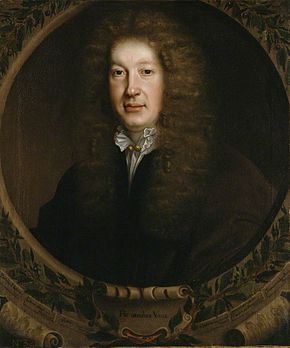
John Dryden
(1)
Poem topics: , Print This Poem , Rhyme Scheme
Submit Spanish Translation
Submit German Translation
Submit French Translation
<< Prologue[1] To His Royal Highness, Poem
Prologue To "the Loyal Brother; Or, The Persian Prince;"[1] By Mr Southern, 1682. Poem>>
About To Her Grace The Duchess Of Ormond,[1]
To Her Grace The Duchess Of Ormond,[1] is a poem by John Dryden. This page includes the poem text, poet information, related topics, comments, and similar poems.
Write your comment about To Her Grace The Duchess Of Ormond,[1] poem by John Dryden
Best Poems of John Dryden