Archibald Lowell Poem Rhyme Scheme and Analysis
Rhyme Scheme: ABCDEFGHIDJKLBMNOPMQ RNNSTUVWXPYZA2B2Y SC2D2SNE2FF2G2NNAH2A NI2J2K2GNI2OL2M2NH2N D I2N2TO2P2Q2BHYN2R2S2 T2U2V2KG2G2W2K2NX2 Y2Z2A3B3OC3D3E3F3Z2G 2G3H3I3T2H2NJ3K3J2PA Q2 L3M3N3XK3RO3NS ANP3N3N KQ3D3A2R3S3XQ2A2I2NT 3QU3V3YNTT2N AW3T2H2NBX3MT2Y3Z3A4 T2T2K2YB4XYHXC4D4KNE 4NYNIHK2NDO2UF4GG4H4 B2PNI2 I4S2H4YS2HNQ2QD YF4BJ4 NNPK4L4 F4K3NM4N4F2NO4P4TQNB 3M3 KQ4NR4F2S4Q2T4WYS4U4 V4K4N2Q2W4AI YX4Y4V2 NR3Z4YNNHBZ3Q| Archibald Lowell owner of the Times | A |
| Lived six months of the year at Sunnyside | B |
| His Gothic castle near LeRoy so named | C |
| Because no sun was in him it may be | D |
| His wife was much away when on this earth | E |
| At cures in travel fighting psychic ills | F |
| Approaching madness dying nerves They said | G |
| Her heart was starved for living with a man | H |
| So cold and silent Thirty years she lived | I |
| Bound to this man in restless agony | D |
| And as she could not free her life from his | J |
| Nor keep it living with him on a day | K |
| She stuck a gas hose in her mouth and drank | L |
| Her lungs full of the lethal stuff and died | B |
| That was the very day the hunter found | M |
| Elenor Murray's body near the river | N |
| A servant saw this Mrs Lowell lying | O |
| A copy of the Times clutched in her hand | P |
| Which published that a slip of paper found | M |
| In Elenor Murray's pocket had these words | Q |
| To be brave and not to flinch And was she brave | R |
| And nerved to end it by these words of Elenor | N |
| But Archibald the husband could not bear | N |
| To have the death by suicide made known | S |
| He laid the body out as if his wife | T |
| Had gone to bed as usual turned a jet | U |
| And left it just as if his wife had failed | V |
| To fully turn it then went in the room | W |
| Then called the servants did not know that one | X |
| Had seen her with the Times clutched in her hand | P |
| He thought the matter hidden Merival | Y |
| All occupied with Elenor Murray's death | Z |
| Gave to a deputy the Lowell inquest | A2 |
| But later what this servant saw was told | B2 |
| To Merival | Y |
| - | |
| And now no more alone | S |
| Than when his wife lived Lowell passed the days | C2 |
| At Sunnyside as he had done for years | D2 |
| He sat alone and paced the rooms alone | S |
| With hands behind him clasped in fear and wonder | N |
| Of life and what life is He rode about | E2 |
| And viewed his blooded cattle on the hills | F |
| But what were all these rooms and acres to him | F2 |
| With no face near him but the servants gardeners | G2 |
| Sometimes he wished he had a child to draw | N |
| Upon his fabulous income growing more | N |
| Since all his life was centered in the Times | A |
| To swell its revenues and in the process | H2 |
| His spirit was more fully in the Times | A |
| Than in his body There were eyes who saw | N |
| How deftly was his spirit woven in it | I2 |
| Until it was a scarf to bind and choke | J2 |
| The public throat or stifle honest thought | K2 |
| Like a soft pillow offered for the head | G |
| But used to smother There were eyes who saw | N |
| The working of its ways emasculate | I2 |
| Its tones of gray where flame had been the thing | O |
| Its timorous steps while spying on the public | L2 |
| To learn the public's thought Its cautious pauses | M2 |
| With foot uplifted ears pricked up to hear | N |
| A step fall twig break Platitudes in progress | H2 |
| With sugar coat of righteousness and order | N |
| Respectability | D |
| - | |
| Did the public make it | I2 |
| Or did it make the public that it fitted | N2 |
| With such exactness in the communal life | T |
| Some thousands thought it fair what should they think | O2 |
| When it played neutral in the matter of news | P2 |
| To both sides of the question though at last | Q2 |
| It turned the judge and chose the better side | B |
| Determined from the first a secret plan | H |
| And cunning way to turn the public scale | Y |
| Some thousands liked the kind of news it printed | N2 |
| Where no sensation flourished smallest type | R2 |
| That fixed attention for the staring eyes | S2 |
| Needed for type so small But others knew | T2 |
| It led the people by its fair pretensions | U2 |
| And used them in the end In any case | V2 |
| This editor played hand ball in this way | K |
| The advertisers tossed the ball the readers | G2 |
| Caught it and tossed it to the advertisers | G2 |
| And as the readers multiplied the columns | W2 |
| Of advertising grew and Lowell's thought | K2 |
| Was how to play the one against the other | N |
| And fill his purse | X2 |
| - | |
| It was an ingrown mind | Y2 |
| And growing more ingrown with time Afraid | Z2 |
| Of crowds and streets uncomfortable in clubs | A3 |
| No warmth in hands to touch his fellows' hands | B3 |
| Keeping aloof from politicians loathing | O |
| The human alderman who bails the thief | C3 |
| The little scamp who pares a little profit | D3 |
| And grafts upon a branch that takes no harm | E3 |
| He loved the active spirit if it worked | F3 |
| And feared the active spirit if it played | Z2 |
| This Lowell hid himself from favor seekers | G2 |
| Such letters filtered to him through a sieve | G3 |
| Of secretaries If he had a friend | H3 |
| Who was a mind to him as well perhaps | I3 |
| It was a certain lawyer but who knew | T2 |
| And cursed with monophobia none the less | H2 |
| This Lowell lived alone there near LeRoy | N |
| Surrounded by his servants at his desk | J3 |
| A secretary named McGill who took | K3 |
| Such letters editorials as he spoke | J2 |
| His life was nearly waste A peanut stand | P |
| Should be as much remembered as the Times | A |
| When fifty years are passed | Q2 |
| - | |
| And every month | L3 |
| The circulation manager came down | M3 |
| To tell the great man of the gain or loss | N3 |
| The paper made that month in circulation | X |
| In advertising chiefly Lowell took | K3 |
| The audit sheets and studied them and gave | R |
| Steel bullet words of order this or that | O3 |
| He took the dividends and put them where | N |
| God knew alone | S |
| - | |
| He went to church sometimes | A |
| On certain Sundays for a pious mother | N |
| Had reared him so and sat there like a corpse | P3 |
| A desiccated soul so dry the moss | N3 |
| Upon his teeth was dry | N |
| - | |
| And on a day | K |
| His wife now in the earth a week or so | Q3 |
| Himself not well the doctor there to quiet | D3 |
| His fears of sudden death pains in the chest | A2 |
| His manager had come was made to wait | R3 |
| Until the doctor finished brought the sheets | S3 |
| Which showed the advertising circulation | X |
| And Lowell studied them and said at last | Q2 |
| That new reporter makes the Murray inquest | A2 |
| A thing of interest does the public like it | I2 |
| To which the manager It sells the paper | N |
| And then the great man It has served its use | T3 |
| Now being nearly over print these words | Q |
| The Murray inquest shows to what a length | U3 |
| Fantastic wit can go it should be stopped | V3 |
| An editorial later might be well | Y |
| Comment upon a father and a mother | N |
| Invaded in their privacy and life | T |
| In intimate relations dragged to view | T2 |
| To sate the curious eye | N |
| - | |
| Next day the Times | A |
| Rebuked the coroner in these words And then | W3 |
| Merival sent word I come to see you | T2 |
| Or else you come to see me or by process | H2 |
| If you refuse And so the editor | N |
| Invited Merival to Sunnyside | B |
| To talk the matter out This was the talk | X3 |
| First Merival went over all the ground | M |
| In mild locution what he sought to do | T2 |
| How as departments in the war had studied | Y3 |
| Disease and what not tabulated facts | Z3 |
| He wished to make a start for knowing lives | A4 |
| And finding remedies for lives It's true | T2 |
| Not much might be accomplished also true | T2 |
| The poet and the novelist gave thought | K2 |
| Analysis to lives yet who could tell | Y |
| What system might grow up to find the fault | B4 |
| In marriage as it is in rearing children | X |
| In motherhood in homes for Merival | Y |
| By way of wit said to this dullest man | H |
| I know of mother and of home of heaven | X |
| I've yet to learn Whereat the great man winced | C4 |
| To hear the home and motherhood so slurred | D4 |
| And briefly said the Times would go its way | K |
| To serve the public interests and to foster | N |
| American ideals as he conceived them | E4 |
| Then Merival who knew the great man's nature | N |
| How small it was and barren cold and dull | Y |
| And wedded to small things to gold and fear | N |
| Of change and knew the life the woman lived | I |
| These seven days in the earth with such a man | H |
| Just by a zephyr of intangible thought | K2 |
| Veered round the talk to her to voice a wonder | N |
| About the jet left turned his deputy | D |
| Had overlooked a hose which she could drink | O2 |
| Gas from a jet You needn't touch the jet | U |
| Just leave it as she left it hide the hose | F4 |
| And leave the gas on put the woman in bed | G |
| This deputy said Merival was slack | G4 |
| And let a verdict pass of accident | H4 |
| Oh yes said Merival your servant told | B2 |
| About the hose the Times clutched in her hand | P |
| And may I test this jet while I am here | N |
| Go up to see and test it | I2 |
| - | |
| Whereupon | I4 |
| The great man with wide eyes stared in the eyes | S2 |
| Of Merival was speechless for a moment | H4 |
| Not knowing what to say while Merival | Y |
| Read something in his eyes saw in his eyes | S2 |
| The secret beat to cover saw the man | H |
| Turn head away which shook a little saw | N |
| His chest expand for breath and heard at last | Q2 |
| The editor in four steel bullet words | Q |
| It is not necessary | D |
| - | |
| Merival | Y |
| Had trapped the solitary fox arose | F4 |
| And going said If it was suicide | B |
| The inquest must be changed | J4 |
| - | |
| The editor | N |
| Looked through the window at the coroner | N |
| Walking the gravel walk and saw his hand | P |
| Unlatch the iron gate and saw him pass | K4 |
| From view behind the trees | L4 |
| - | |
| Then horror rose | F4 |
| Within his brain a nameless horror took | K3 |
| The heart of him for fear this coroner | N |
| Would dig this secret up and show the world | M4 |
| The dead face of the woman self destroyed | N4 |
| And of the talk which would not come to him | F2 |
| To poison air he breathed no less of why | N |
| This woman took her life if for ill health | O4 |
| Then why ill health O well he knew at heart | P4 |
| What he had done to break her starve her life | T |
| And now accused himself too much for words | Q |
| Ways temperament of him that murdered her | N |
| For lovelessness and for deliberate hands | B3 |
| That pushed her off and down | M3 |
| - | |
| He rode that day | K |
| To see his cattle overlook the work | Q4 |
| But when night came with silence and the cry | N |
| Of night hawks and the elegy of leaves | R4 |
| Beneath the stars that looked so cold at him | F2 |
| As he turned seeking sleep the dreaded pain | S4 |
| Grew stronger in his breast Dawn came at last | Q2 |
| And then the stir and voices of the maids | T4 |
| And after breakfast in the carven room | W |
| Archibald Lowell standing by the mantel | Y |
| In his great library felt sudden pain | S4 |
| Saw sudden darkness nothing saw at once | U4 |
| Lying upon the marble of the hearth | V4 |
| His great head cut which struck the post of brass | K4 |
| In the hearth's railing only a little blood | N2 |
| Archibald Lowell being dead at last | Q2 |
| The Times left to the holders of the stock | W4 |
| Who kept his policy and kept the Times | A |
| As if the great man lived | I |
| - | |
| And Merival | Y |
| Taking the doctor's word that death was caused | X4 |
| By angina pectoris let it drop | Y4 |
| And went his way with Elenor Murray's case | V2 |
| - | |
| - | |
| - | |
| So Lowell's dead and buried had to die | N |
| But not through Elenor Murray That's the Fate | R3 |
| That laughs at greatness little things that sneak | Z4 |
| From alien neighborhoods of life and kill | Y |
| And Lowell leaves a will to which a boy | N |
| Who sold the Times once afterward the Star | N |
| Is alien as this Elenor to the man | H |
| Who owned the Times But still is brought in touch | |
| With Lowell's will because this Lowell died | B |
| Before he died And Merival learns the facts | Z3 |
| And brings them to the jury in these words | Q |
Edgar Lee Masters
(1)
Poem topics: , Print This Poem , Rhyme Scheme
Submit Spanish Translation
Submit German Translation
Submit French Translation
About Archibald Lowell
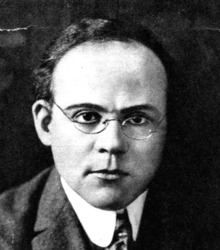
Archibald Lowell is a poem by Edgar Lee Masters. This page includes the poem text, poet information, related topics, comments, and similar poems.
Write your comment about Archibald Lowell poem by Edgar Lee Masters
Best Poems of Edgar Lee Masters