Imitations Of Horace: The First Epistle Of The Second Book Poem Rhyme Scheme and Analysis
Rhyme Scheme: ABCCDDEEFFGGHHIIJJKK AALM NNFFOPQQ PPRSPPPPTTEE UUEEVV WWXXYQ EE PPZZ A2A2 AAXXAA EEPPPPPPPP B2B2PPPPXXC2C2 PPZZEED2D2PPPPE2WF2F 2EE ZZAAZZC2C2 A2A2ZZ XXPPZZC2C2CCEEBD2ZZE EPP PPPPEEZZG2G2EEPPPPAA PPZZ H2H2EEAAPPI2Z| Ne Rubeam Pingui donatus Munere | A |
| Horace Epistles II i | B |
| While you great patron of mankind sustain | C |
| The balanc'd world and open all the main | C |
| Your country chief in arms abroad defend | D |
| At home with morals arts and laws amend | D |
| How shall the Muse from such a monarch steal | E |
| An hour and not defraud the public weal | E |
| Edward and Henry now the boast of fame | F |
| And virtuous Alfred a more sacred name | F |
| After a life of gen'rous toils endur'd | G |
| The Gaul subdu'd or property secur'd | G |
| Ambition humbled mighty cities storm'd | H |
| Or laws establish'd and the world reform'd | H |
| Clos'd their long glories with a sigh to find | I |
| Th' unwilling gratitude of base mankind | I |
| All human virtue to its latest breath | J |
| Finds envy never conquer'd but by death | J |
| The great Alcides ev'ry labour past | K |
| Had still this monster to subdue at last | K |
| Sure fate of all beneath whose rising ray | A |
| Each star of meaner merit fades away | A |
| Oppress'd we feel the beam directly beat | L |
| Those suns of glory please not till they set | M |
| - | |
| To thee the world its present homage pays | N |
| The harvest early but mature the praise | N |
| Great friend of liberty in kings a name | F |
| Above all Greek above all Roman fame | F |
| Whose word is truth as sacred and rever'd | O |
| As Heav'n's own oracles from altars heard | P |
| Wonder of kings like whom to mortal eyes | Q |
| None e'er has risen and none e'er shall rise | Q |
| - | |
| Just in one instance be it yet confest | P |
| Your people Sir are partial in the rest | P |
| Foes to all living worth except your own | R |
| And advocates for folly dead and gone | S |
| Authors like coins grow dear as they grow old | P |
| It is the rust we value not the gold | P |
| Chaucer's worst ribaldry is learn'd by rote | P |
| And beastly Skelton heads of houses quote | P |
| One likes no language but the Faery Queen | T |
| A Scot will fight for Christ's Kirk o' the Green | T |
| And each true Briton is to Ben so civil | E |
| He swears the Muses met him at the Devil | E |
| - | |
| Though justly Greece her eldest sons admires | U |
| Why should not we be wiser than our sires | U |
| In ev'ry public virtue we excel | E |
| We build we paint we sing we dance as well | E |
| And learned Athens to our art must stoop | V |
| Could she behold us tumbling through a hoop | V |
| - | |
| If time improve our wit as well as wine | W |
| Say at what age a poet grows divine | W |
| Shall we or shall we not account him so | X |
| Who died perhaps an hundred years ago | X |
| End all dispute and fix the year precise | Y |
| When British bards begin t'immortalize | Q |
| - | |
| Who lasts a century can have no flaw | E |
| I hold that wit a classic good in law | E |
| - | |
| Suppose he wants a year will you compound | P |
| And shall we deem him ancient right and sound | P |
| Or damn to all eternity at once | Z |
| At ninety nine a modern and a dunce | Z |
| - | |
| We shall not quarrel for a year or two | A2 |
| By courtesy of England he may do | A2 |
| - | |
| Then by the rule that made the horsetail bare | A |
| I pluck out year by year as hair by hair | A |
| And melt down ancients like a heap of snow | X |
| While you to measure merits look in Stowe | X |
| And estimating authors by the year | A |
| Bestow a garland only on a bier | A |
| - | |
| Shakespeare whom you and ev'ry playhouse bill | E |
| Style the divine the matchless what you will | E |
| For gain not glory wing'd his roving flight | P |
| And grew immortal in his own despite | P |
| Ben old and poor as little seem'd to heed | P |
| The life to come in ev'ry poet's creed | P |
| Who now reads Cowley if he pleases yet | P |
| His moral pleases not his pointed wit | P |
| Forgot his epic nay Pindaric art | P |
| But still I love the language of his heart | P |
| - | |
| Yet surely surely these were famous men | B2 |
| What boy but hears the sayings of old Ben | B2 |
| In all debates where critics bear a part | P |
| Not one but nods and talks of Jonson's art | P |
| Of Shakespeare's nature and of Cowley's wit | P |
| How Beaumont's judgment check'd what Fletcher writ | P |
| How Shadwell hasty Wycherley was slow | X |
| But for the passions Southerne sure and Rowe | X |
| These only these support the crowded stage | C2 |
| From eldest Heywood down to Cibber's age | C2 |
| - | |
| All this may be the people's voice is odd | P |
| It is and it is not the voice of God | P |
| To Gammer Gurton if it give the bays | Z |
| And yet deny the Careless Husband praise | Z |
| Or say our fathers never broke a rule | E |
| Why then I say the public is a fool | E |
| But let them own that greater faults than we | D2 |
| They had and greater virtues I'll agree | D2 |
| Spenser himself affects the obsolete | P |
| And Sidney's verse halts ill on Roman feet | P |
| Milton's strong pinion now not Heav'n can bound | P |
| Now serpent like in prose he sweeps the ground | P |
| In quibbles angel and archangel join | E2 |
| And God the Father turns a school divine | W |
| Not that I'd lop the beauties from his book | F2 |
| Like slashing Bentley with his desp'rate hook | F2 |
| Or damn all Shakespeare like th' affected fool | E |
| At court who hates whate'er he read at school | E |
| - | |
| - | |
| But for the wits of either Charles's days | Z |
| The mob of gentlemen who wrote with ease | Z |
| Sprat Carew Sedley and a hundred more | A |
| Like twinkling stars the Miscellanies o'er | A |
| One simile that solitary shines | Z |
| In the dry desert of a thousand lines | Z |
| Or lengthen'd thought that gleams through many a page | C2 |
| Has sanctified whole poems for an age | C2 |
| - | |
| - | |
| I lose my patience and I own it too | A2 |
| When works are censur'd not as bad but new | A2 |
| While if our elders break all reason's laws | Z |
| These fools demand not pardon but applause | Z |
| - | |
| - | |
| On Avon's bank where flow'rs eternal blow | X |
| If I but ask if any weed can grow | X |
| One tragic sentence if I dare deride | P |
| Which Betterton's grave action dignified | P |
| Or well mouth'd Booth with emphasis proclaims | Z |
| Though but perhaps a muster roll of names | Z |
| How will our fathers rise up in a rage | C2 |
| And swear all shame is lost in George's age | C2 |
| You'd think no fools disgrac'd the former reign | C |
| Did not some grave examples yet remain | C |
| Who scorn a lad should teach his father skill | E |
| And having once been wrong will be so still | E |
| He who to seem more deep than you or I | B |
| Extols old bards or Merlin's Prophecy | D2 |
| Mistake him not he envies not admires | Z |
| And to debase the sons exalts the sires | Z |
| Had ancient times conspir'd to disallow | E |
| What then was new what had been ancient now | E |
| Or what remain'd so worthy to be read | P |
| By learned critics of the mighty dead | P |
| - | |
| - | |
| In days of ease when now the weary sword | P |
| Was sheath'd and luxury with Charles restor'd | P |
| In ev'ry taste of foreign courts improv'd | P |
| All by the King's example liv'd and lov'd | P |
| Then peers grew proud in horsemanship t'excel | E |
| Newmarket's glory rose as Britain's fell | E |
| The soldier breath'd the gallantries of France | Z |
| And ev'ry flow'ry courtier writ romance | Z |
| Then marble soften'd into life grew warm | G2 |
| And yielding metal flow'd to human form | G2 |
| Lely on animated canvas stole | E |
| The sleepy eye that spoke the melting soul | E |
| No wonder then when all was love and sport | P |
| The willing Muses were debauch'd at court | P |
| On each enervate string they taught the note | P |
| To pant or tremble through an eunuch's throat | P |
| But Britain changeful as a child at play | A |
| Now calls in princes and now turns away | A |
| Now Whig now Tory what we lov'd we hate | P |
| Now all for pleasure now for Church and state | P |
| Now for prerogative and now for laws | Z |
| Effects unhappy from a noble cause | Z |
| - | |
| - | |
| Time was a sober Englishman would knock | H2 |
| His servants up and rise by five o'clock | H2 |
| Instruct his family in ev'ry rule | E |
| And send his wife to church his son to school | E |
| To worship like his fathers was his care | A |
| To teach their frugal virtues to his heir | A |
| To prove that luxury could never hold | P |
| And place on good security his gold | P |
| Now times are chang'd and one poetic itch | I2 |
| Has sei | Z |
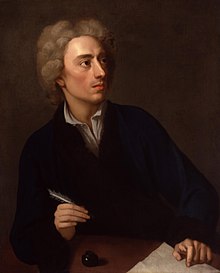
Alexander Pope
(1)
Poem topics: , Print This Poem , Rhyme Scheme
Submit Spanish Translation
Submit German Translation
Submit French Translation
About Imitations Of Horace: The First Epistle Of The Second Book
Imitations Of Horace: The First Epistle Of The Second Book is a poem by Alexander Pope. This page includes the poem text, poet information, related topics, comments, and similar poems.