An Essay On Man In Four Epistles: Epistle 1 Poem Rhyme Scheme and Analysis
Rhyme Scheme: ABBCCDDEEFFGGHHDC IIJKLLMNOOPPHQRR SC TTUUVVWW VVSSXDAA YYXXZZLLRR A2A2VVVVCV VVB2B2C2D2IC VVIIVVVVIIYYVV GGIIVVE2F2 VVVVIIVVVVKKCW G2H2I2I2VVD2D2VVHHHH J2K2HW IIPPIIHHHH VVL2L2HHIIHHHHHHIIHH VVHHVV C2JVH| To Henry St John Lord Bolingbroke | A |
| Awake my St John leave all meaner things | B |
| To low ambition and the pride of kings | B |
| Let us since life can little more supply | C |
| Than just to look about us and to die | C |
| Expatiate free o'er all this scene of man | D |
| A mighty maze but not without a plan | D |
| A wild where weeds and flow'rs promiscuous shoot | E |
| Or garden tempting with forbidden fruit | E |
| Together let us beat this ample field | F |
| Try what the open what the covert yield | F |
| The latent tracts the giddy heights explore | G |
| Of all who blindly creep or sightless soar | G |
| Eye Nature's walks shoot folly as it flies | H |
| And catch the manners living as they rise | H |
| Laugh where we must be candid where we can | D |
| But vindicate the ways of God to man I | C |
| - | |
| Say first of God above or man below | I |
| What can we reason but from what we know | I |
| Of man what see we but his station here | J |
| From which to reason or to which refer | K |
| Through worlds unnumber'd though the God be known | L |
| 'Tis ours to trace him only in our own | L |
| He who through vast immensity can pierce | M |
| See worlds on worlds compose one universe | N |
| Observe how system into system runs | O |
| What other planets circle other suns | O |
| What varied being peoples ev'ry star | P |
| May tell why Heav'n has made us as we are | P |
| But of this frame the bearings and the ties | H |
| The strong connections nice dependencies | Q |
| Gradations just has thy pervading soul | R |
| Look'd through or can a part contain the whole | R |
| - | |
| Is the great chain that draws all to agree | S |
| And drawn supports upheld by God or thee II | C |
| - | |
| Presumptuous man the reason wouldst thou find | T |
| Why form'd so weak so little and so blind | T |
| First if thou canst the harder reason guess | U |
| Why form'd no weaker blinder and no less | U |
| Ask of thy mother earth why oaks are made | V |
| Taller or stronger than the weeds they shade | V |
| Or ask of yonder argent fields above | W |
| Why Jove's satellites are less than Jove | W |
| - | |
| Of systems possible if 'tis confest | V |
| That Wisdom infinite must form the best | V |
| Where all must full or not coherent be | S |
| And all that rises rise in due degree | S |
| Then in the scale of reas'ning life 'tis plain | X |
| There must be somewhere such a rank as man | D |
| And all the question wrangle e'er so long | A |
| Is only this if God has plac'd him wrong | A |
| - | |
| Respecting man whatever wrong we call | Y |
| May must be right as relative to all | Y |
| In human works though labour'd on with pain | X |
| A thousand movements scarce one purpose gain | X |
| In God's one single can its end produce | Z |
| Yet serves to second too some other use | Z |
| So man who here seems principal alone | L |
| Perhaps acts second to some sphere unknown | L |
| Touches some wheel or verges to some goal | R |
| 'Tis but a part we see and not a whole | R |
| - | |
| When the proud steed shall know why man restrains | A2 |
| His fiery course or drives him o'er the plains | A2 |
| When the dull ox why now he breaks the clod | V |
| Is now a victim and now Egypt's God | V |
| Then shall man's pride and dulness comprehend | V |
| His actions' passions' being's use and end | V |
| Why doing suff'ring check'd impell'd and why | C |
| This hour a slave the next a deity | V |
| - | |
| Then say not man's imperfect Heav'n in fault | V |
| Say rather man's as perfect as he ought | V |
| His knowledge measur'd to his state and place | B2 |
| His time a moment and a point his space | B2 |
| If to be perfect in a certain sphere | C2 |
| What matter soon or late or here or there | D2 |
| The blest today is as completely so | I |
| As who began a thousand years ago III | C |
| - | |
| Heav'n from all creatures hides the book of fate | V |
| All but the page prescrib'd their present state | V |
| From brutes what men from men what spirits know | I |
| Or who could suffer being here below | I |
| The lamb thy riot dooms to bleed today | V |
| Had he thy reason would he skip and play | V |
| Pleas'd to the last he crops the flow'ry food | V |
| And licks the hand just rais'd to shed his blood | V |
| Oh blindness to the future kindly giv'n | I |
| That each may fill the circle mark'd by Heav'n | I |
| Who sees with equal eye as God of all | Y |
| A hero perish or a sparrow fall | Y |
| Atoms or systems into ruin hurl'd | V |
| And now a bubble burst and now a world | V |
| - | |
| Hope humbly then with trembling pinions soar | G |
| Wait the great teacher Death and God adore | G |
| What future bliss he gives not thee to know | I |
| But gives that hope to be thy blessing now | I |
| Hope springs eternal in the human breast | V |
| Man never is but always to be blest | V |
| The soul uneasy and confin'd from home | E2 |
| Rests and expatiates in a life to come | F2 |
| - | |
| Lo the poor Indian whose untutor'd mind | V |
| Sees God in clouds or hears him in the wind | V |
| His soul proud science never taught to stray | V |
| Far as the solar walk or milky way | V |
| Yet simple nature to his hope has giv'n | I |
| Behind the cloud topp'd hill an humbler heav'n | I |
| Some safer world in depth of woods embrac'd | V |
| Some happier island in the wat'ry waste | V |
| Where slaves once more their native land behold | V |
| No fiends torment no Christians thirst for gold | V |
| To be contents his natural desire | K |
| He asks no angel's wing no seraph's fire | K |
| But thinks admitted to that equal sky | C |
| His faithful dog shall bear him company IV | W |
| - | |
| - | |
| Go wiser thou and in thy scale of sense | G2 |
| Weigh thy opinion against Providence | H2 |
| Call imperfection what thou fanciest such | I2 |
| Say here he gives too little there too much | I2 |
| Destroy all creatures for thy sport or gust | V |
| Yet cry if man's unhappy God's unjust | V |
| If man alone engross not Heav'n's high care | D2 |
| Alone made perfect here immortal there | D2 |
| Snatch from his hand the balance and the rod | V |
| Rejudge his justice be the God of God | V |
| In pride in reas'ning pride our error lies | H |
| All quit their sphere and rush into the skies | H |
| Pride still is aiming at the blest abodes | H |
| Men would be angels angels would be gods | H |
| Aspiring to be gods if angels fell | J2 |
| Aspiring to be angels men rebel | K2 |
| And who but wishes to invert the laws | H |
| Of order sins against th' Eternal Cause V | W |
| - | |
| - | |
| Ask for what end the heav'nly bodies shine | I |
| Earth for whose use Pride answers 'Tis for mine | I |
| For me kind Nature wakes her genial pow'r | P |
| Suckles each herb and spreads out ev'ry flow'r | P |
| Annual for me the grape the rose renew | I |
| The juice nectareous and the balmy dew | I |
| For me the mine a thousand treasures brings | H |
| For me health gushes from a thousand springs | H |
| Seas roll to waft me suns to light me rise | H |
| My foot stool earth my canopy the skies | H |
| - | |
| - | |
| But errs not Nature from this gracious end | V |
| From burning suns when livid deaths descend | V |
| When earthquakes swallow or when tempests sweep | L2 |
| Towns to one grave whole nations to the deep | L2 |
| No 'tis replied the first Almighty Cause | H |
| Acts not by partial but by gen'ral laws | H |
| Th' exceptions few some change since all began | I |
| And what created perfect Why then man | I |
| If the great end be human happiness | H |
| Then Nature deviates and can man do less | H |
| As much that end a constant course requires | H |
| Of show'rs and sunshine as of man's desires | H |
| As much eternal springs and cloudless skies | H |
| As men for ever temp'rate calm and wise | H |
| If plagues or earthquakes break not Heav'n's design | I |
| Why then a Borgia or a Catiline | I |
| Who knows but he whose hand the lightning forms | H |
| Who heaves old ocean and who wings the storms | H |
| Pours fierce ambition in a C aelig sar's mind | V |
| Or turns young Ammon loose to scourge mankind | V |
| From pride from pride our very reas'ning springs | H |
| Account for moral as for nat'ral things | H |
| Why charge we Heav'n in those in these acquit | V |
| In both to reason right is to submit | V |
| - | |
| - | |
| Better for us perhaps it might appear | C2 |
| Were there all harmony all virtue here | J |
| That never air or ocean felt the wind | V |
| That never pass | H |
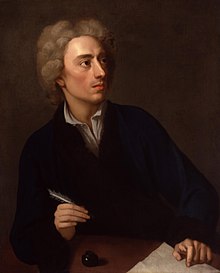
Alexander Pope
(1)
Poem topics: , Print This Poem , Rhyme Scheme
Submit Spanish Translation
Submit German Translation
Submit French Translation
<< Summer Poem
Phyrne Poem>>
About An Essay On Man In Four Epistles: Epistle 1
An Essay On Man In Four Epistles: Epistle 1 is a poem by Alexander Pope. This page includes the poem text, poet information, related topics, comments, and similar poems.