An Essay On Man: Epistle Ii Poem Rhyme Scheme and Analysis
Rhyme Scheme: ABBCCDDEFGHIIJJKKLL MMNNOHPPNNQQ RRSS TTUUVVNN DDWXYYZZA2A2 AYYKKB2B2 C2C2UUD2D2E2E2 F2G2H2H2AAI2J2K2K2UU L2L2 M2M2N2N2O2O2P2GGQ2R2 R2 AKKDDHHO2O2 S2T2EEC2C2U2U2TT M2M2V2V2W2PYYTTX2X2 H2H2TTY2Y2O2O2EE Z2Z2A3A3O2O2C2C2B3B3 VV C3C3Q2GD3D3E3E3UUF3F 3K2K2G3G3 H3I3J3J3K3K3T2S2L3L3 I2I2DD B2M3N3| I | A |
| Know then thyself presume not God to scan | B |
| The proper study of mankind is man | B |
| Plac'd on this isthmus of a middle state | C |
| A being darkly wise and rudely great | C |
| With too much knowledge for the sceptic side | D |
| With too much weakness for the stoic's pride | D |
| He hangs between in doubt to act or rest | E |
| In doubt to deem himself a god or beast | F |
| In doubt his mind or body to prefer | G |
| Born but to die and reas'ning but to err | H |
| Alike in ignorance his reason such | I |
| Whether he thinks too little or too much | I |
| Chaos of thought and passion all confus'd | J |
| Still by himself abus'd or disabus'd | J |
| Created half to rise and half to fall | K |
| Great lord of all things yet a prey to all | K |
| Sole judge of truth in endless error hurl'd | L |
| The glory jest and riddle of the world | L |
| - | |
| Go wondrous creature mount where science guides | M |
| Go measure earth weigh air and state the tides | M |
| Instruct the planets in what orbs to run | N |
| Correct old time and regulate the sun | N |
| Go soar with Plato to th' empyreal sphere | O |
| To the first good first perfect and first fair | H |
| Or tread the mazy round his follow'rs trod | P |
| And quitting sense call imitating God | P |
| As Eastern priests in giddy circles run | N |
| And turn their heads to imitate the sun | N |
| Go teach Eternal Wisdom how to rule | Q |
| Then drop into thyself and be a fool | Q |
| - | |
| Superior beings when of late they saw | R |
| A mortal Man unfold all Nature's law | R |
| Admir'd such wisdom in an earthly shape | S |
| And showed a Newton as we shew an Ape | S |
| - | |
| Could he whose rules the rapid comet bind | T |
| Describe or fix one movement of his mind | T |
| Who saw its fires here rise and there descend | U |
| Explain his own beginning or his end | U |
| Alas what wonder Man's superior part | V |
| Uncheck'd may rise and climb from art to art | V |
| But when his own great work is but begun | N |
| What Reason weaves by Passion is undone | N |
| - | |
| Trace science then with modesty thy guide | D |
| First strip off all her equipage of pride | D |
| Deduct what is but vanity or dress | W |
| Or learning's luxury or idleness | X |
| Or tricks to show the stretch of human brain | Y |
| Mere curious pleasure or ingenious pain | Y |
| Expunge the whole or lop th' excrescent parts | Z |
| Of all our Vices have created Arts | Z |
| Then see how little the remaining sum | A2 |
| Which serv'd the past and must the times to come | A2 |
| - | |
| - | |
| II | A |
| Two principles in human nature reign | Y |
| Self love to urge and reason to restrain | Y |
| Nor this a good nor that a bad we call | K |
| Each works its end to move or govern all | K |
| And to their proper operation still | B2 |
| Ascribe all good to their improper ill | B2 |
| - | |
| Self love the spring of motion acts the soul | C2 |
| Reason's comparing balance rules the whole | C2 |
| Man but for that no action could attend | U |
| And but for this were active to no end | U |
| Fix'd like a plant on his peculiar spot | D2 |
| To draw nutrition propagate and rot | D2 |
| Or meteor like flame lawless through the void | E2 |
| Destroying others by himself destroy'd | E2 |
| - | |
| Most strength the moving principle requires | F2 |
| Active its task it prompts impels inspires | G2 |
| Sedate and quiet the comparing lies | H2 |
| Form'd but to check delib'rate and advise | H2 |
| Self love still stronger as its objects nigh | A |
| Reason's at distance and in prospect lie | A |
| That sees immediate good by present sense | I2 |
| Reason the future and the consequence | J2 |
| Thicker than arguments temptations throng | K2 |
| At best more watchful this but that more strong | K2 |
| The action of the stronger to suspend | U |
| Reason still use to reason still attend | U |
| Attention habit and experience gains | L2 |
| Each strengthens reason and self love restrains | L2 |
| - | |
| Let subtle schoolmen teach these friends to fight | M2 |
| More studious to divide than to unite | M2 |
| And grace and virtue sense and reason split | N2 |
| With all the rash dexterity of wit | N2 |
| Wits just like fools at war about a name | O2 |
| Have full as oft no meaning or the same | O2 |
| Self love and reason to one end aspire | P2 |
| Pain their aversion pleasure their desire | G |
| But greedy that its object would devour | G |
| This taste the honey and not wound the flow'r | Q2 |
| Pleasure or wrong or rightly understood | R2 |
| Our greatest evil or our greatest good | R2 |
| - | |
| - | |
| III | A |
| Modes of self love the passions we may call | K |
| 'Tis real good or seeming moves them all | K |
| But since not every good we can divide | D |
| And reason bids us for our own provide | D |
| Passions though selfish if their means be fair | H |
| List under reason and deserve her care | H |
| Those that imparted court a nobler aim | O2 |
| Exalt their kind and take some virtue's name | O2 |
| - | |
| In lazy apathy let Stoics boast | S2 |
| Their virtue fix'd 'tis fix'd as in a frost | T2 |
| Contracted all retiring to the breast | E |
| But strength of mind is exercise not rest | E |
| The rising tempest puts in act the soul | C2 |
| Parts it may ravage but preserves the whole | C2 |
| On life's vast ocean diversely we sail | U2 |
| Reason the card but passion is the gale | U2 |
| Nor God alone in the still calm we find | T |
| He mounts the storm and walks upon the wind | T |
| - | |
| Passions like elements though born to fight | M2 |
| Yet mix'd and soften'd in his work unite | M2 |
| These 'tis enough to temper and employ | V2 |
| But what composes man can man destroy | V2 |
| Suffice that reason keep to nature's road | W2 |
| Subject compound them follow her and God | P |
| Love hope and joy fair pleasure's smiling train | Y |
| Hate fear and grief the family of pain | Y |
| These mix'd with art and to due bounds confin'd | T |
| Make and maintain the balance of the mind | T |
| The lights and shades whose well accorded strife | X2 |
| Gives all the strength and colour of our life | X2 |
| - | |
| Pleasures are ever in our hands or eyes | H2 |
| And when in act they cease in prospect rise | H2 |
| Present to grasp and future still to find | T |
| The whole employ of body and of mind | T |
| All spread their charms but charm not all alike | Y2 |
| On diff'rent senses diff'rent objects strike | Y2 |
| Hence diff'rent passions more or less inflame | O2 |
| As strong or weak the organs of the frame | O2 |
| And hence one master passion in the breast | E |
| Like Aaron's serpent swallows up the rest | E |
| - | |
| As man perhaps the moment of his breath | Z2 |
| Receives the lurking principle of death | Z2 |
| The young disease that must subdue at length | A3 |
| Grows with his growth and strengthens with his strength | A3 |
| So cast and mingled with his very frame | O2 |
| The mind's disease its ruling passion came | O2 |
| Each vital humour which should feed the whole | C2 |
| Soon flows to this in body and in soul | C2 |
| Whatever warms the heart or fills the head | B3 |
| As the mind opens and its functions spread | B3 |
| Imagination plies her dang'rous art | V |
| And pours it all upon the peccant part | V |
| - | |
| Nature its mother habit is its nurse | C3 |
| Wit spirit faculties but make it worse | C3 |
| Reason itself but gives it edge and pow'r | Q2 |
| As Heav'n's blest beam turns vinegar more sour | G |
| We wretched subjects though to lawful sway | D3 |
| In this weak queen some fav'rite still obey | D3 |
| Ah if she lend not arms as well as rules | E3 |
| What can she more than tell us we are fools | E3 |
| Teach us to mourn our nature not to mend | U |
| A sharp accuser but a helpless friend | U |
| Or from a judge turn pleader to persuade | F3 |
| The choice we make or justify it made | F3 |
| Proud of an easy conquest all along | K2 |
| She but removes weak passions for the strong | K2 |
| So when small humours gather to a gout | G3 |
| The doctor fancies he has driv'n them out | G3 |
| - | |
| Yes nature's road must ever be preferr'd | H3 |
| Reason is here no guide but still a guard | I3 |
| 'Tis hers to rectify not overthrow | J3 |
| And treat this passion more as friend than foe | J3 |
| A mightier pow'r the strong direction sends | K3 |
| And sev'ral men impels to sev'ral ends | K3 |
| Like varying winds by other passions toss'd | T2 |
| This drives them constant to a certain coast | S2 |
| Let pow'r or knowledge gold or glory please | L3 |
| Or oft more strong than all the love of ease | L3 |
| Through life 'tis followed ev'n at life's expense | I2 |
| The merchant's toil the sage's indolence | I2 |
| The monk's humility the hero's pride | D |
| All all alike find reason on their side | D |
| - | |
| Th' eternal art educing good from ill | B2 |
| Grafts on this passion our best principle | M3 |
| 'Tis th | N3 |
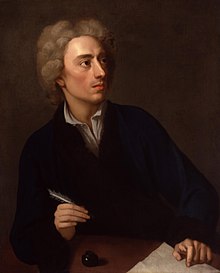
Alexander Pope
(1)
Poem topics: , Print This Poem , Rhyme Scheme
Submit Spanish Translation
Submit German Translation
Submit French Translation
About An Essay On Man: Epistle Ii
An Essay On Man: Epistle Ii is a poem by Alexander Pope. This page includes the poem text, poet information, related topics, comments, and similar poems.