The Lay Of The Last Minstrel: Canto Iv. Poem Rhyme Scheme and Analysis
Rhyme Scheme: ABCBCDDEFFE AGHGHIIJAKJLLLMM ANONOPQRSAATT BUBUVVUUWWXXU TTYYYTTUUUZZA2TB2B2C 2CC2C HHD2STTXXCCUUUMMB2B2 UU HZZTUTUUUUZE2W HHUHUF2F2HHG2TTH2TTU U H2UTUUTXXUUZZUUUUH2H 2UUZZUUUU H2UZUZZZXXUUUUMMU UUZ XXTTXXUU H2H2H2B2B2UUTTT UUTTZZTTUUMMUUU H2TTUUU H2H2XXTU| I | A |
| Sweet Teviot on thy silver tide | B |
| The glaring bale fires blaze no more | C |
| No longer steel clad warrior ride | B |
| Along thy wild and willow'd shore | C |
| Where'er thou wind'st by dale or hill | D |
| All all is peaceful all is still | D |
| As if thy waves since Time was born | E |
| Since first they roll'd upon the Tweed | F |
| Had only heard the shepherd's reed | F |
| Nor started at the bugle horn | E |
| - | |
| II | A |
| Unlike the tide of human time | G |
| Which though it change in ceaseless flow | H |
| Retains each grief retains each crime | G |
| Its earliest course was doom'd to know | H |
| And darker as it downward bears | I |
| Is stain'd with past and present tears | I |
| Low as that tide has ebb'd with me | J |
| It still reflects to Memory's eye | A |
| The hour my brave my only boy | K |
| Fell by the side of great Dundee | J |
| Why when the volleying musket play'd | L |
| Against the bloody Highland blade | L |
| Why was not I beside him laid | L |
| Enough he died the death of fame | M |
| Enough he died with conquering Graeme | M |
| - | |
| III | A |
| Now over Border dale and fell | N |
| Full wide and far was terror spread | O |
| For pathless marsh and mountain cell | N |
| The peasant left his lowly shed | O |
| The frighten'd flocks and herds were pent | P |
| Beneath the peel's rude battlement | Q |
| And maids and matrons dropp'd the tear | R |
| While ready warriors seiz'd the spear | S |
| From Branksome's towers the watchman's eye | A |
| Dun wreaths of distant smoke can spy | A |
| Which curling in the rising sun | T |
| Show'd southern ravage was begun | T |
| - | |
| IV | - |
| Now loud the heedful gate ward cried | B |
| 'Prepare ye all for blows and blood | U |
| Watt Tinlinn from the Liddel side | B |
| Comes wading through the flood | U |
| Full oft the Tynedale snatchers knock | V |
| At his lone gate and prove the lock | V |
| It was but last St Barnabright | U |
| They sieg'd him a whole summer night | U |
| But fled at morning well they knew | W |
| In vain he never twang'd the yew | W |
| Right sharp has been the evening shower | X |
| That drove him from his Liddel tower | X |
| And by my faith ' the gate ward said | U |
| 'I think 'twill prove a Warden Raid ' | - |
| - | |
| V | - |
| While thus he spoke the bold yeoman | T |
| Enter'd the echoing barbican | T |
| He led a small and shaggy nag | Y |
| That through a bog from hag to hag | Y |
| Could bound like any Billhope stag | Y |
| It bore his wife and children twain | T |
| A half clothed serf was all their train | T |
| His wife stout ruddy and dark brow'd | U |
| Of silver brooch and bracelet proud | U |
| Laugh'd to her friends among the crowd | U |
| He was of stature passing tall | Z |
| But sparely form'd and lean withal | Z |
| A batter'd morion on his brow | A2 |
| A leather jack as fence enow | T |
| On his broad shoulders loosely hung | B2 |
| A border axe behind was slung | B2 |
| His spear six Scottish ells in length | C2 |
| Seem'd newly dyed with gore | C |
| His shafts and bow of wondrous strength | C2 |
| His hardy partner bore | C |
| - | |
| VI | - |
| Thus to the Ladye did Tinlinn show | H |
| The tidings of the English foe | H |
| 'Belted Will Howard is marching here | D2 |
| And hot Lord Dacre with many a spear | S |
| And all the German hackbut men | T |
| Who have long lain at Askerten | T |
| They cross'd the Liddel at curfew hour | X |
| And burn'd my little lonely tower | X |
| The fiend receive their souls therefore | C |
| It had not been burnt this year and more | C |
| Barn yard and dwelling blazing bright | U |
| Serv'd to guide me on my flight | U |
| But I was chas'd the livelong night | U |
| Black John of Akeshaw and Fergus Graeme | M |
| Fast upon my traces came | M |
| Until I turn'd at Priesthaugh Scrogg | B2 |
| And shot their horses in the bog | B2 |
| Slew Fergus with my lance outright | U |
| I had him long at high despite | U |
| He drove my cows last Fastern's night ' | - |
| - | |
| VII | H |
| Now weary scouts from Liddesdale | Z |
| Fast hurrying in confirm'd the tale | Z |
| As far as they could judge by ken | T |
| Three hours would bring to Teviot's strand | U |
| Three thousand armed Englishmen | T |
| Meanwhile full many a warlike band | U |
| From Teviot Aill and Ettrick shade | U |
| Came in their Chief's defence to aid | U |
| There was saddling and mounting in haste | U |
| There was pricking o'er moor and lea | Z |
| He that was last at the trysting place | E2 |
| Was but lightly held of his gay ladye | W |
| - | |
| VIII | H |
| From fair St Mary's silver wave | H |
| From dreary Gamescleugh's dusky height | U |
| His ready lances Thirlestane brave | H |
| Array'd beneath a banner bright | U |
| The treasured fleur de luce he claims | F2 |
| To wreathe his shield since royal James | F2 |
| Encamp'd by Fala's mossy wave | H |
| The proud distinction grateful gave | H |
| For faith 'mid feudal jars | G2 |
| What time save Thirlestane alone | T |
| Of Scotland's stubborn barons none | T |
| Would march to southern wars | H2 |
| And hence in fair remembrance worn | T |
| Yon sheaf of spears his crest has borne | T |
| Hence his high motto shines reveal'd | U |
| ' Ready aye ready' for the field | U |
| - | |
| IX | H2 |
| An aged Knight to danger steel'd | U |
| With manyaa moss trooper came on | T |
| And azure in a golden field | U |
| The stars and crescent graced his shield | U |
| Without the bend of Murdieston | T |
| Wide lay his lands round Oakwood tower | X |
| And wide round haunted Castle Ower | X |
| High over Borthwick's mountain flood | U |
| His wood embosom'd mansion stood | U |
| In the dark glen so deep below | Z |
| The herds of plunder'd England low | Z |
| His bold retainers' daily food | U |
| And bought with danger blows and blood | U |
| Marauding chief his sole delight | U |
| The moonlight raid the morning fight | U |
| Not even the Flower of Yarrow's charms | H2 |
| In youth might tame his rage for arms | H2 |
| And still in age he spurn'd at rest | U |
| And still his brows the helmet press'd | U |
| Albeit the blanched locks below | Z |
| Were white as Dinlay's spotless snow | Z |
| Five stately warriors drew the sword | U |
| Before their father's band | U |
| A braver knight than Harden's lord | U |
| Ne'er belted on a brand | U |
| - | |
| X | H2 |
| Scotts of Eskdale a stalwart band | U |
| Came trooping down the Todshaw hill | Z |
| By the sword they won their land | U |
| And by the sword they hold it still | Z |
| Hearken Ladye to the tale | Z |
| How thy sires won fair Eskdale | Z |
| Earl Morton was lord of that valley fair | X |
| The Beattisons were his vassals there | X |
| The Earl was gentle and mild of mood | U |
| The vassals vere warlike and fierce and rude | U |
| High of heart and haughty of word | U |
| Little they reck'd of a tame liege lord | U |
| The Earl into fair Eskdale came | M |
| Homage and seignory to claim | M |
| Of Gilbert the Galliard a heriot he sought | U |
| Saying 'Give thy best steed as a vassal ought ' | - |
| 'Dear to me is my bonny white steed | U |
| Oft has he help d me at pinch of need | U |
| Lord and Earl though thou be I trow | Z |
| I can rein Bucksfoot better than thou ' | - |
| Word on word gave fuel to fire | X |
| Till so highly blazed the Beattison's ire | X |
| But that the Earl the flight had ta'en | T |
| The vassals there their lord had slain | T |
| Sore he plied both whip and spur | X |
| As he urged his steed through Eskdale muir | X |
| And it fell down a weary weight | U |
| Just on the threshold of Branksome gate | U |
| - | |
| XI | H2 |
| The Earl was a wrathful man to see | H2 |
| Full fain avenged would he be | H2 |
| In haste to Branksome's Lord he spoke | B2 |
| Saying 'Take these traitors to thy yoke | B2 |
| For a cast of hawks and a purse of gold | U |
| All Eskdale I'll sell thee to have and hold | U |
| Beshrew thy heart of the Beattisons' clan | T |
| If thou leavest on Eske a landed man | T |
| But spare Woodkerrick's lands alone | T |
| For he lent me his horse to escape upon ' | - |
| A glad man then was Branksome bold | U |
| Down he flung him the purse of gold | U |
| To Eskdale soon he spurr'd amain | T |
| And with him five hundred riders has ta'en | T |
| He left his merrymen in the mist of the hill | Z |
| And bade them hold them close and still | Z |
| And alone he wended to the plain | T |
| To meet with the Galliard and all his train | T |
| To Gilbert the Galliard thus he said | U |
| 'Know thou me for thy liege lord and head | U |
| Deal not with me as with Morton tame | M |
| For Scotts play best at the roughest game | M |
| Give me in peace my heriot due | U |
| Thy bonny white steed or thou shalt rue | U |
| If my horn I three times wind | U |
| Eskdale shall long have the sound in mind ' | - |
| - | |
| XII | H2 |
| Loudly the Beattison laugh'd in scorn | T |
| 'Little care we for thy winded horn | T |
| Ne'er shall it be the Galliard's lot | U |
| To yield his steed to a haughty Scott | U |
| Wend thou to Branksome back on foot | U |
| With rusty spur and miry boot ' | - |
| He blew his bugle so loud and hoarse | H2 |
| That the dun deer started at fair Craikcross | H2 |
| He blew again so loud and clear | X |
| Through the grey mountain mist there did lances appear | X |
| And the third blast rang with such a din | T |
| That the echoes answer'd | U |
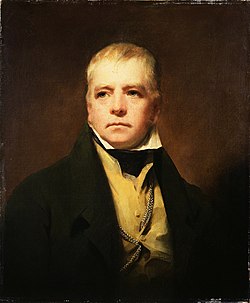
Sir Walter Scott
(1)
Poem topics: , Print This Poem , Rhyme Scheme
Submit Spanish Translation
Submit German Translation
Submit French Translation
About The Lay Of The Last Minstrel: Canto Iv.
The Lay Of The Last Minstrel: Canto Iv. is a poem by Sir Walter Scott. This page includes the poem text, poet information, related topics, comments, and similar poems.
Write your comment about The Lay Of The Last Minstrel: Canto Iv. poem by Sir Walter Scott
Best Poems of Sir Walter Scott