To Mr. Delany,[1] Poem Rhyme Scheme and Analysis
Rhyme Scheme: A BBCCDDEEFFGGHHDDIIJJ KKLLMNOOPPQQRRSSTTUU VVWWDDXXYYZA2JJB2B2C 2C2D2D2E2E2F2F2AAG2G 2H2H2I2I2J2K2K2K2L2L 2D2EM2M2K2K2BBK2K2PP K2K2H2H2H2H2K2K2TTH2 H2K2K2H2H2H2H2H2H2N2 N2| OCT NINE IN THE MORNING | A |
| - | |
| To you whose virtues I must own | B |
| With shame I have too lately known | B |
| To you by art and nature taught | C |
| To be the man I long have sought | C |
| Had not ill Fate perverse and blind | D |
| Placed you in life too far behind | D |
| Or what I should repine at more | E |
| Placed me in life too far before | E |
| To you the Muse this verse bestows | F |
| Which might as well have been in prose | F |
| No thought no fancy no sublime | G |
| But simple topics told in rhyme | G |
| Three gifts for conversation fit | H |
| Are humour raillery and wit | H |
| The last as boundless as the wind | D |
| Is well conceived though not defined | D |
| For sure by wit is only meant | I |
| Applying what we first invent | I |
| What humour is not all the tribe | J |
| Of logic mongers can describe | J |
| Here only nature acts her part | K |
| Unhelp'd by practice books or art | K |
| For wit and humour differ quite | L |
| That gives surprise and this delight | L |
| Humour is odd grotesque and wild | M |
| Only by affectation spoil'd | N |
| 'Tis never by invention got | O |
| Men have it when they know it not | O |
| Our conversation to refine | P |
| True humour must with wit combine | P |
| From both we learn to rally well | Q |
| Wherein French writers most excel | Q |
| Voiture in various lights displays | R |
| That irony which turns to praise | R |
| His genius first found out the rule | S |
| For an obliging ridicule | S |
| He flatters with peculiar air | T |
| The brave the witty and the fair | T |
| And fools would fancy he intends | U |
| A satire where he most commends | U |
| But as a poor pretending beau | V |
| Because he fain would make a show | V |
| Nor can afford to buy gold lace | W |
| Takes up with copper in the place | W |
| So the pert dunces of mankind | D |
| Whene'er they would be thought refined | D |
| Because the diff'rence lies abstruse | X |
| 'Twixt raillery and gross abuse | X |
| To show their parts will scold and rail | Y |
| Like porters o'er a pot of ale | Y |
| Such is that clan of boisterous bears | Z |
| Always together by the ears | A2 |
| Shrewd fellows and arch wags a tribe | J |
| That meet for nothing but to gibe | J |
| Who first run one another down | B2 |
| And then fall foul on all the town | B2 |
| Skill'd in the horse laugh and dry rub | C2 |
| And call'd by excellence The Club | C2 |
| I mean your butler Dawson Car | D2 |
| All special friends and always jar | D2 |
| The mettled and the vicious steed | E2 |
| Do not more differ in their breed | E2 |
| Nay Voiture is as like Tom Leigh | F2 |
| As rudeness is to repartee | F2 |
| If what you said I wish unspoke | A |
| 'Twill not suffice it was a joke | A |
| Reproach not though in jest a friend | G2 |
| For those defects he cannot mend | G2 |
| His lineage calling shape or sense | H2 |
| If named with scorn gives just offence | H2 |
| What use in life to make men fret | I2 |
| Part in worse humour than they met | I2 |
| Thus all society is lost | J2 |
| Men laugh at one another's cost | K2 |
| And half the company is teazed | K2 |
| That came together to be pleased | K2 |
| For all buffoons have most in view | L2 |
| To please themselves by vexing you | L2 |
| When jests are carried on too far | D2 |
| And the loud laugh begins the war | E |
| You keep your countenance for shame | M2 |
| Yet still you think your friend to blame | M2 |
| For though men cry they love a jest | K2 |
| 'Tis but when others stand the test | K2 |
| And would you have their meaning known | B |
| They love a jest when 'tis their own | B |
| You wonder now to see me write | K2 |
| So gravely where the subject's light | K2 |
| Some part of what I here design | P |
| Regards a friend of yours and mine | P |
| Who full of humour fire and wit | K2 |
| Not always judges what is fit | K2 |
| But loves to take prodigious rounds | H2 |
| And sometimes walks beyond his bounds | H2 |
| You must although the point be nice | H2 |
| Venture to give him some advice | H2 |
| Few hints from you will set him right | K2 |
| And teach him how to be polite | K2 |
| Bid him like you observe with care | T |
| Whom to be hard on whom to spare | T |
| Nor indiscreetly to suppose | H2 |
| All subjects like Dan Jackson's nose | H2 |
| To study the obliging jest | K2 |
| By reading those who teach it best | K2 |
| For prose I recommend Voiture's | H2 |
| For verse I speak my judgment yours | H2 |
| He'll find the secret out from thence | H2 |
| To rhyme all day without offence | H2 |
| And I no more shall then accuse | H2 |
| The flirts of his ill manner'd Muse | H2 |
| If he be guilty you must mend him | N2 |
| If he be innocent defend him | N2 |
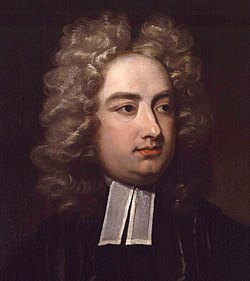
Jonathan Swift
(1)
Poem topics: , Print This Poem , Rhyme Scheme
Submit Spanish Translation
Submit German Translation
Submit French Translation
About To Mr. Delany,[1]
To Mr. Delany,[1] is a poem by Jonathan Swift. This page includes the poem text, poet information, related topics, comments, and similar poems.
Write your comment about To Mr. Delany,[1] poem by Jonathan Swift
Best Poems of Jonathan Swift