To My Honoured Friend Sir Robert Howard,[1] On His Excellent Poems Poem Rhyme Scheme and Analysis
Rhyme Scheme: AABBCCDDEEFFGHIIJKHH LLMMNNOPJJQQRRSSTTUU VVTTWXYYGGZZA2A2B2B2 UUTTC2ND2D2E2E2BBF2F 2TTG2G2DDLLH2H2I2I2J 2J2K2K2BBL2M2N2O2P2P 2LLK2K2GGFBQ2Q2R2R2| As there is music uninform'd by art | A |
| In those wild notes which with a merry heart | A |
| The birds in unfrequented shades express | B |
| Who better taught at home yet please us less | B |
| So in your verse a native sweetness dwells | C |
| Which shames composure and its art excels | C |
| Singing no more can your soft numbers grace | D |
| Than paint adds charms unto a beauteous face | D |
| Yet as when mighty rivers gently creep | E |
| Their even calmness does suppose them deep | E |
| Such is your muse no metaphor swell'd high | F |
| With dangerous boldness lifts her to the sky | F |
| Those mounting fancies when they fall again | G |
| Show sand and dirt at bottom do remain | H |
| So firm a strength and yet withal so sweet | I |
| Did never but in Samson's riddle meet | I |
| 'Tis strange each line so great a weight should bear | J |
| And yet no sign of toil no sweat appear | K |
| Either your art hides art as Stoics feign | H |
| Then least to feel when most they suffer pain | H |
| And we dull souls admire but cannot see | L |
| What hidden springs within the engine be | L |
| Or 'tis some happiness that still pursues | M |
| Each act and motion of your graceful muse | M |
| Or is it fortune's work that in your head | N |
| The curious net that is for fancies spread | N |
| Lets through its meshes every meaner thought | O |
| While rich ideas there are only caught | P |
| Sure that's not all this is a piece too fair | J |
| To be the child of chance and not of care | J |
| No atoms casually together hurl'd | Q |
| Could e'er produce so beautiful a world | Q |
| Nor dare I such a doctrine here admit | R |
| As would destroy the providence of wit | R |
| 'Tis your strong genius then which does not feel | S |
| Those weights would make a weaker spirit reel | S |
| To carry weight and run so lightly too | T |
| Is what alone your Pegasus can do | T |
| Great Hercules himself could ne'er do more | U |
| Than not to feel those heavens and gods he bore | U |
| Your easier odes which for delight were penn'd | V |
| Yet our instruction make their second end | V |
| We're both enrich'd and pleased like them that woo | T |
| At once a beauty and a fortune too | T |
| Of moral knowledge poesy was queen | W |
| And still she might had wanton wits not been | X |
| Who like ill guardians lived themselves at large | Y |
| And not content with that debauch'd their charge | Y |
| Like some brave captain your successful pen | G |
| Restores the exiled to her crown again | G |
| And gives us hope that having seen the days | Z |
| When nothing flourish'd but fanatic bays | Z |
| All will at length in this opinion rest | A2 |
| A sober prince's government is best | A2 |
| This is not all your art the way has found | B2 |
| To make the improvement of the richest ground | B2 |
| That soil which those immortal laurels bore | U |
| That once the sacred Maro's temples wore | U |
| Eliza's griefs are so express'd by you | T |
| They are too eloquent to have been true | T |
| Had she so spoke neas had obey'd | C2 |
| What Dido rather than what Jove had said | N |
| If funeral rites can give a ghost repose | D2 |
| Your Muse so justly has discharged those | D2 |
| Eliza's shade may now its wandering cease | E2 |
| And claim a title to the fields of peace | E2 |
| But if neas be obliged no less | B |
| Your kindness great Achilles doth confess | B |
| Who dress'd by Statius in too bold a look | F2 |
| Did ill become those virgin robes he took | F2 |
| To understand how much we owe to you | T |
| We must your numbers with your author's view | T |
| Then we shall see his work was lamely rough | G2 |
| Each figure stiff as if design'd in buff | G2 |
| His colours laid so thick on every place | D |
| As only show'd the paint but hid the face | D |
| But as in perspective we beauties see | L |
| Which in the glass not in the picture be | L |
| So here our sight obligingly mistakes | H2 |
| That wealth which his your bounty only makes | H2 |
| Thus vulgar dishes are by cooks disguised | I2 |
| More for their dressing than their substance prized | I2 |
| Your curious notes so search into that age | J2 |
| When all was fable but the sacred page | J2 |
| That since in that dark night we needs must stray | K2 |
| We are at least misled in pleasant way | K2 |
| But what we most admire your verse no less | B |
| The prophet than the poet doth confess | B |
| Ere our weak eyes discern'd the doubtful streak | L2 |
| Of light you saw great Charles his morning break | M2 |
| So skilful seamen ken the land from far | N2 |
| Which shows like mists to the dull passenger | O2 |
| To Charles your Muse first pays her duteous love | P2 |
| As still the ancients did begin from Jove | P2 |
| With Monk you end whose name preserved shall be | L |
| As Rome recorded Rufus' memory | L |
| Who thought it greater honour to obey | K2 |
| His country's interest than the world to sway | K2 |
| But to write worthy things of worthy men | G |
| Is the peculiar talent of your pen | G |
| Yet let me take your mantle up and I | F |
| Will venture in your right to prophesy | B |
| This work by merit first of fame secure | Q2 |
| Is likewise happy in its geniture | Q2 |
| For since 'tis born when Charles ascends the throne | R2 |
| It shares at once his fortune and its own | R2 |
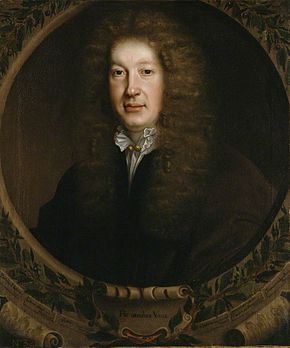
John Dryden
(1)
Poem topics: , Print This Poem , Rhyme Scheme
Submit Spanish Translation
Submit German Translation
Submit French Translation
<< Prologue To "troilus And Cressida." Poem
Epitaph On Sir Palmes Fairbone's Tomb In Westminster Abbey Poem>>
About To My Honoured Friend Sir Robert Howard,[1] On His Excellent Poems
To My Honoured Friend Sir Robert Howard,[1] On His Excellent Poems is a poem by John Dryden. This page includes the poem text, poet information, related topics, comments, and similar poems.
Write your comment about To My Honoured Friend Sir Robert Howard,[1] On His Excellent Poems poem by John Dryden
Best Poems of John Dryden