The Cook's Tale Poem Rhyme Scheme and Analysis
Rhyme Scheme: ABCCDEFGHHIHHJKLMMN OHHHHPPQQRJ SOOOTHOHL U HHVUUULLHHKKHWXYZHHH A2B2UXC2LLLLOUJLD2 HHHHHHHHHHOHD2D2LE2H HULHHD2F2| THE Cook of London while the Reeve thus spake | A |
| For joy he laugh'd and clapp'd him on the back | B |
| 'Aha ' quoth he 'for Christes passion | C |
| This Miller had a sharp conclusion | C |
| Upon this argument of herbergage lodging | D |
| Well saide Solomon in his language | E |
| Bring thou not every man into thine house | F |
| For harbouring by night is perilous | G |
| Well ought a man avised for to be a man should take good heed | H |
| Whom that he brought into his privity | H |
| I pray to God to give me sorrow and care | I |
| If ever since I highte Hodge of Ware was called | H |
| Heard I a miller better set a work handled | H |
| He had a jape of malice in the derk trick | J |
| But God forbid that we should stinte here stop | K |
| And therefore if ye will vouchsafe to hear | L |
| A tale of me that am a poore man | M |
| I will you tell as well as e'er I can | M |
| A little jape that fell in our city ' | N |
| - | |
| Our Host answer'd and said 'I grant it thee | O |
| Roger tell on and look that it be good | H |
| For many a pasty hast thou letten blood | H |
| And many a Jack of Dover lt gt hast thou sold | H |
| That had been twice hot and twice cold | H |
| Of many a pilgrim hast thou Christe's curse | P |
| For of thy parsley yet fare they the worse | P |
| That they have eaten in thy stubble goose | Q |
| For in thy shop doth many a fly go loose | Q |
| Now tell on gentle Roger by thy name | R |
| But yet I pray thee be not wroth for game angry with my jesting | J |
| A man may say full sooth in game and play ' | - |
| 'Thou sayst full sooth ' quoth Roger 'by my fay | S |
| But sooth play quad play lt gt as the Fleming saith | O |
| And therefore Harry Bailly by thy faith | O |
| Be thou not wroth else we departe here part company | O |
| Though that my tale be of an hostelere innkeeper | T |
| But natheless I will not tell it yet | H |
| But ere we part y wis thou shalt be quit ' lt gt assuredly | O |
| And therewithal he laugh'd and made cheer lt gt | H |
| And told his tale as ye shall after hear | L |
| - | |
| THE TALE | U |
| - | |
| - | |
| A prentice whilom dwelt in our city | H |
| And of a craft of victuallers was he | H |
| Galliard he was as goldfinch in the shaw lively grove | V |
| Brown as a berry a proper short fellaw | U |
| With lockes black combed full fetisly daintily | U |
| And dance he could so well and jollily | U |
| That he was called Perkin Revellour | L |
| He was as full of love and paramour | L |
| As is the honeycomb of honey sweet | H |
| Well was the wenche that with him might meet | H |
| At every bridal would he sing and hop | K |
| He better lov'd the tavern than the shop | K |
| For when there any riding was in Cheap lt gt | H |
| Out of the shoppe thither would he leap | W |
| And till that he had all the sight y seen | X |
| And danced well he would not come again | Y |
| And gather'd him a meinie of his sort company of fellows | Z |
| To hop and sing and make such disport | H |
| And there they sette steven for to meet made appointment | H |
| To playen at the dice in such a street | H |
| For in the towne was there no prentice | A2 |
| That fairer coulde cast a pair of dice | B2 |
| Than Perkin could and thereto he was free he spent money liberally | U |
| Of his dispence in place of privity where he would not be seen | X |
| That found his master well in his chaffare merchandise | C2 |
| For oftentime he found his box full bare | L |
| For soothely a prentice revellour | L |
| That haunteth dice riot and paramour | L |
| His master shall it in his shop abie suffer for | L |
| All have he no part of the minstrelsy although | O |
| For theft and riot they be convertible | U |
| All can they play on gitern or ribible guitar or rebeck | J |
| Revel and truth as in a low degree | L |
| They be full wroth all day as men may see at variance | D2 |
| - | |
| This jolly prentice with his master bode | H |
| Till he was nigh out of his prenticehood | H |
| All were he snubbed both early and late rebuked | H |
| And sometimes led with revel to Newgate | H |
| But at the last his master him bethought | H |
| Upon a day when he his paper lt gt sought | H |
| Of a proverb that saith this same word | H |
| Better is rotten apple out of hoard | H |
| Than that it should rot all the remenant | H |
| So fares it by a riotous servant | H |
| It is well lesse harm to let him pace pass go | O |
| Than he shend all the servants in the place corrupt | H |
| Therefore his master gave him a quittance | D2 |
| And bade him go with sorrow and mischance | D2 |
| And thus this jolly prentice had his leve desire | L |
| Now let him riot all the night or leave refrain | E2 |
| And for there is no thief without a louke lt gt | H |
| That helpeth him to wasten and to souk spend | H |
| Of that he bribe can or borrow may steal | U |
| Anon he sent his bed and his array | L |
| Unto a compere of his owen sort comrade | H |
| That loved dice and riot and disport | H |
| And had a wife that held for countenance for appearances | D2 |
| A shop and swived for her sustenance prostituted herself | F2 |
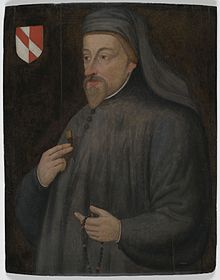
Geoffrey Chaucer
(1)
Poem topics: , Print This Poem , Rhyme Scheme
Submit Spanish Translation
Submit German Translation
Submit French Translation
About The Cook's Tale
The Cook's Tale is a poem by Geoffrey Chaucer. This page includes the poem text, poet information, related topics, comments, and similar poems.
Write your comment about The Cook's Tale poem by Geoffrey Chaucer
Best Poems of Geoffrey Chaucer