To Charles Cowden Clarke Poem Rhyme Scheme and Analysis
Rhyme Scheme: AABBCCDDEEFFGGHHIIJJ GGKLLLLLMMJJNNOOOPPQ QRRMMGGQQSSTTQQMMUUG GVVWWAAGGXXQQUUYYUUA AIIUUUULLUUBBBZZUUU QQLLQQQQA2A2A2A2AAUU A2A2A2A2A2A2LLQQUUB2 A2A2| Oft have you seen a swan superbly frowning | A |
| And with proud breast his own white shadow crowning | A |
| He slants his neck beneath the waters bright | B |
| So silently it seems a beam of light | B |
| Come from the galaxy anon he sports | C |
| With outspread wings the Naiad Zephyr courts | C |
| Or ruffles all the surface of the lake | D |
| In striving from its crystal face to take | D |
| Some diamond water drops and them to treasure | E |
| In milky nest and sip them off at leisure | E |
| But not a moment can he there insure them | F |
| Nor to such downy rest can he allure them | F |
| For down they rush as though they would be free | G |
| And drop like hours into eternity | G |
| Just like that bird am I in loss of time | H |
| Whene'er I venture on the stream of rhyme | H |
| With shatter'd boat oar snapt and canvass rent | I |
| I slowly sail scarce knowing my intent | I |
| Still scooping up the water with my fingers | J |
| In which a trembling diamond never lingers | J |
| - | |
| By this friend Charles you may full plainly see | G |
| Why I have never penn d a line to thee | G |
| Because my thoughts were never free and clear | K |
| And little fit to please a classic ear | L |
| Because my wine was of too poor a savour | L |
| For one whose palate gladdens in the flavour | L |
| Of sparkling Helicon small good it were | L |
| To take him to a desert rude and bare | L |
| Who had on Baiae's shore reclin'd at ease | M |
| While Tasso's page was floating in a breeze | M |
| That gave soft music from Armida's bowers | J |
| Mingled with fragrance from her rarest flowers | J |
| Small good to one who had by Mulla's stream | N |
| Fondled the maidens with the breasts of cream | N |
| Who had beheld Belphoebe in a brook | O |
| And lovely Una in a leafy nook | O |
| And Archimago leaning o'er his book | O |
| Who had of all that's sweet tasted and seen | P |
| From silv'ry ripple up to beauty's queen | P |
| From the sequester'd haunts of gay Titania | Q |
| To the blue dwelling of divine Urania | Q |
| One who of late had ta'en sweet forest walks | R |
| With him who elegantly chats and talks | R |
| The wrong'd Libertas who has told you stories | M |
| Of laurel chaplets and Apollo s glories | M |
| Of troops chivalrous prancing through a city | G |
| And tearful ladies made for love and pity | G |
| With many else which I have never known | Q |
| Thus have I thought and days on days have flown | Q |
| Slowly or rapidly unwilling still | S |
| For you to try my dull unlearned quill | S |
| Nor should I now but that I've known you long | T |
| That you first taught me all the sweets of song | T |
| The grand the sweet the terse the free the fine | Q |
| What swell'd with pathos and what right divine | Q |
| Spenserian vowels that elope with ease | M |
| And float along like birds o'er summer seas | M |
| Miltonian storms and more Miltonian tenderness | U |
| Michael in arms and more meek Eve s fair slenderness | U |
| Who read for me the sonnet swelling loudly | G |
| Up to its climax and then dying proudly | G |
| Who found for me the grandeur of the ode | V |
| Growing like Atlas stronger from its load | V |
| Who let me taste that more than cordial dram | W |
| The sharp the rapier pointed epigram | W |
| Shew'd me that epic was of all the king | A |
| Round vast and spanning all like Saturn's ring | A |
| You too upheld the veil from Clio's beauty | G |
| And pointed out the patriot's stern duty | G |
| The might of Alfred and the shaft of Tell | X |
| The hand of Brutus that so grandly fell | X |
| Upon a tyrant's head Ah had I never seen | Q |
| Or known your kindness what might I have been | Q |
| What my enjoyments in my youthful years | U |
| Bereft of all that now my life endears | U |
| And can I e'er these benefits forget | Y |
| And can I e'er repay the friendly debt | Y |
| No doubly no yet should these rhymings please | U |
| I shall roll on the grass with two fold ease | U |
| For I have long time been my fancy feeding | A |
| With hopes that you would one day think the reading | A |
| Of my rough verses not an hour mis s pent | I |
| Should it e'er be so what a rich content | I |
| Some weeks have pass'd since last I saw the spires | U |
| In lucent Thames reflected warm desires | U |
| To see the sun o'er peep the eastern dimness | U |
| And morning shadows streaking into slimness | U |
| Across the lawny fields and pebbly water | L |
| To mark the time as they grow broad and shorter | L |
| To feel the air that plays about the hills | U |
| And sips its freshness from the little rills | U |
| To see high golden corn wave in the light | B |
| When Cynthia smiles upon a summer's night | B |
| And peers among the cloudlet's jet and white | B |
| As though she were reclining in a bed | Z |
| Of bean blossoms in heaven freshly shed | Z |
| No sooner had I stepp'd into these pleasures | U |
| Than I began to think of rhymes and measures | U |
| The air that floated by me seem d to say | U |
| 'Write thou wilt never have a better day ' | - |
| And so I did When many lines I d written | Q |
| Though with their grace I was not oversmitten | Q |
| Yet as my hand was warm I thought I d better | L |
| Trust to my feelings and write you a letter | L |
| Such an attempt required an inspiration | Q |
| Of a peculiar sort a consummation | Q |
| Which had I felt these scribblings might have been | Q |
| Verses from which the soul would never wean | Q |
| But many days have past since last my heart | A2 |
| Was warm d luxuriously by divine Mozart | A2 |
| By Arne delighted or by Handel madden'd | A2 |
| Or by the song of Erin pierc d and sadden'd | A2 |
| What time you were before the music sitting | A |
| And the rich notes to each sensation fitting | A |
| Since I have walk'd with you through shady lanes | U |
| That freshly terminate in open plains | U |
| And revel'd in a chat that ceased not | A2 |
| When at night fall among your books we got | A2 |
| No nor when supper came nor after that | A2 |
| Nor when reluctantly I took my hat | A2 |
| No nor till cordially you shook my hand | A2 |
| Mid way between our homes your accents bland | A2 |
| Still sounded in my ears when I no more | L |
| Could hear your footsteps touch the grav ly floor | L |
| Sometimes I lost them and then found again | Q |
| You chang'd the footpath for the grassy plain | Q |
| In those still moments I have wish'd you joys | U |
| That well you know to honour 'Life's very toys | U |
| 'With him ' said I 'will take a pleasant charm | B2 |
| 'It cannot be that ought will work him harm ' | - |
| These thoughts now come o er me with all their might | A2 |
| Again I shake your hand friend Charles good night | A2 |
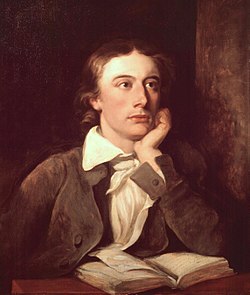
John Keats
(1)
Poem topics: , Print This Poem , Rhyme Scheme
Submit Spanish Translation
Submit German Translation
Submit French Translation
About To Charles Cowden Clarke
To Charles Cowden Clarke is a poem by John Keats. This page includes the poem text, poet information, related topics, comments, and similar poems.
Write your comment about To Charles Cowden Clarke poem by John Keats
Best Poems of John Keats